Originally published: July 17, 2026
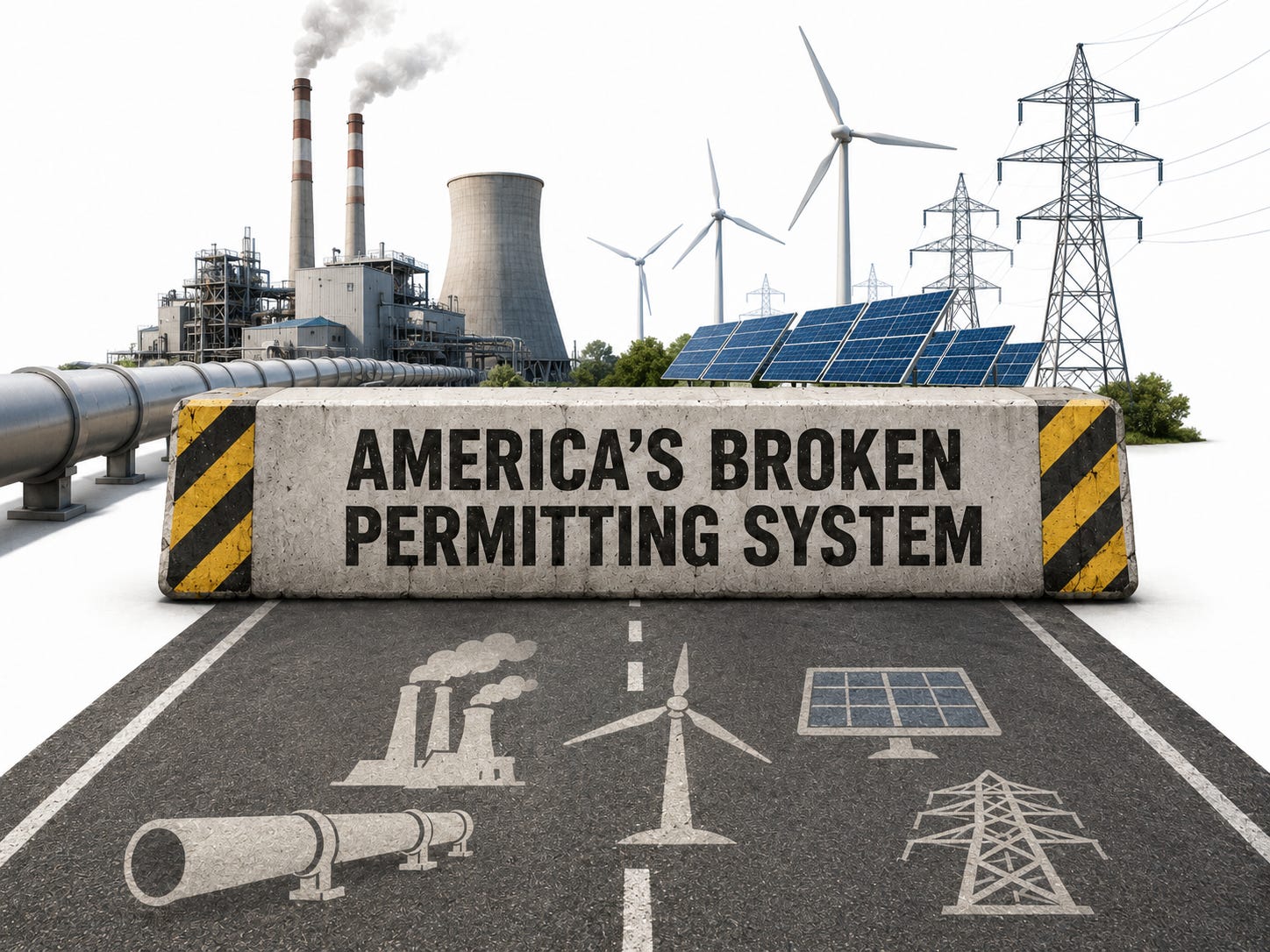
Democrats and Republicans have the opportunity to do something great: fix America’s broken permitting system.
Bipartisan deals are often impossible, but on permitting it’s totally possible—because permitting delays kill projects that members of both parties deeply care about.
-
There are at least 4 areas that both Democrats and Republicans should be eager to aggressively reform
- NEPA
- Clean Water Act
- Permitting certainty
- Electric transmission
Why aggressive NEPA reform is bipartisan
-
Why aggressive National Environmental Policy Act (NEPA) reform is bipartisan
- It unleashes big projects both parties care about
- It poses no threat to environmental quality
-
NEPA was supposed to be a short and non-binding bonus review to confirm that agencies considered the environmental impacts of projects before permitting them.
Today, the bonus environmental review required by NEPA is abused to delay and destroy projects through endless review.
-
NEPA bonus reviews are the #1 blocker of big projects in America—not only typical Republican priorities (power plants, pipelines), but typical Democrat priorities (solar/wind farms, transmission lines) and substantially bipartisan priorities (nuclear plants, geothermal plants).
-
Since the bonus environmental reviews required by NEPA are on top of the environmental reviews already required by law, NEPA reform does not threaten environmental quality.
In fact, NEPA reform speeds up projects that improve environmental quality, e.g., wildfire mitigation.
-
Key NEPA reforms that both parties should support
- Stop courts from killing projects for alleged deficiencies in bonus reviews
- Clarify that bonus reviews have no power to overturn agency decisions
- Only review direct impacts
(All these are in the House-passed SPEED Act)
Why aggressive Clean Water Act reform is bipartisan
-
Why aggressive Clean Water Act Reform is bipartisan
- It helps both electric transmission lines and natural gas pipelines
- It lowers electricity prices
- It poses no threat to water quality
-
The Clean Water Act was supposed to protect waterways from dangerous emissions of liquids and solids.
Today, it being abused to stop interstate natural gas pipelines and electric transmission lines that don’t even emit liquids or solids.
-
The Clean Water Act is known as the #1 blocker of natural gas pipelines (a Republican focus).
But if not reformed, it may soon also block transmission lines (a Democrat focus) through an arbitrary state “certification” process that can kill any water-crossing infrastructure.
-
The Clean Water Act is making electricity unaffordable by creating shortages of natural gas, the leading fuel on our grid (a fact that, like it or not, will not change anytime soon).
Reforming it will lower electricity prices and home heating prices, a bipartisan priority.
-
A common concern, especially among Democrats, is that Clean Water Act reform threatens water quality.
But neither natural gas pipelines nor transmission lines emit liquids or solids that endanger water quality! CWA can be reformed with no decrease in water quality whatsoever.
-
Key Clean Water Act reforms that both parties should support
- Streamline the multiple onerous federal water quality review processes
- Limit the scope of state “certification” of the federal process to real water quality threats
(These are in the House-passed PERMIT Act)
Why permitting certainty is bipartisan
-
Why permitting certainty is bipartisan
- It protects projects both parties care about
- It still blocks any genuinely unlawful project
-
A permit is supposed to certify that a project is legal and give it a green light.
Today, permits are treated as revocable at will, with each new administration canceling projects it dislikes.
This is disastrous for investment because it means no project is ever truly secure.
-
Democrats are focused on permitting certainty because Trump has pulled permits from wind/solar projects.
But Republicans also wanted permitting certainty when Biden retroactively suspended oil and gas leases in Alaska and canceled leases for the Twin Metals mine in MN.
-
A common concern is that permitting certainty would prevent unlawful projects from being stopped if a genuine violation is discovered after a permit is granted.
It wouldn’t. Courts retain the power to immediately halt projects that are found to be truly unlawful or dangerous.
-
Key permitting certainty reforms that both parties should support
- Only courts, not agencies, can stop permitted projects and only if they violate the law
- Set hard deadlines at every stage of the permitting process, with consequences for missing them (as in the FREEDOM Act)
Why Federal Power Act reform is bipartisan
-
Why Federal Power Act reform of transmission policy, if done properly, is bipartisan
- It helps affordability
- It helps reliability
- It helps the growth of American industry
-
Both parties have legitimate objections to today’s transmission policy.
Democrats say it’s too hard to get new transmission built. Republicans say it’s too easy to force ratepayers to fund wasteful transmission.
The solution: make it easier to build cost-effective transmission.
-
It’s currently nearly impossible to build interstate transmission lines because states often veto them to protect utilities from competition.
Democrats are proposing to address this by giving FERC “siting authority” to approve interstate transmission lines over state objections.
-
Easing transmission permitting is dangerous because ratepayers are forced to pay for it.
Republicans fear that under today’s weak standards for assigning transmission costs to ratepayers, allowing FERC to approve lines could unleash wasteful transmission at ratepayers’ expense.
-
The key electric transmission reform that both parties should support
Allow FERC to authorize and force ratepayers to pay for transmission lines over state objections if and only if the transmission line demonstrably saves customers more money than it costs.
-
Tell your Representative, Democrat or Republican, that if they want your vote in the midterm elections they must support a bipartisan permitting deal that aggressively reforms at least 1) NEPA, 2) the Clean Water Act, 3) permitting certainty, and 4) electric transmission policy.
Michelle Hung contributed to this piece.