Originally published: July 14, 2026
-
NRC is right to challenge the “ALARA” rule, which has been catastrophic for nuclear power.
-
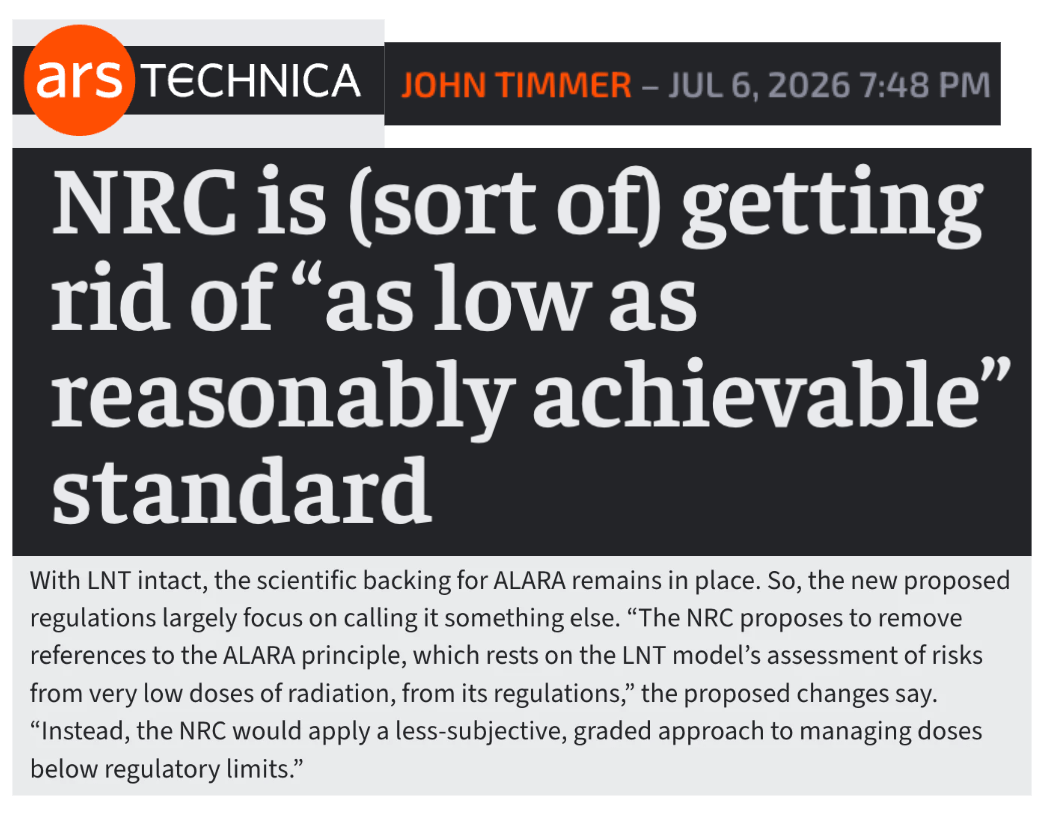
Challenging ALARA is not enough. To unleash nuclear power in this country, the NRC needs to reject “LNT,” the pseudoscientific radiation model on which ALARA is based.1
-
ALARA (”As Low as Reasonably Achievable”) requires nuclear operators to reduce radiation when “reasonably achievable”—even when radiation is below legal limits, which are already far below harmful levels.
This is a major reason nuclear is impossible to build cheaply in America.
-
The “reasonably” in “As Low as Reasonably Achievable” is not clearly defined in NRC regulation. But in practice it’s come to mean any radiation reduction that is technically feasible using existing technology, with little regard for cost.2
-
Thanks to ALARA, nuclear developers spend tens to hundreds of millions of dollars engineering a single plant with unnecessary features such as excessive shielding to reduce radiation below levels people safely experience every day in naturally higher-radiation places like Denver.
-
ALARA is based on a false model of radiation danger called Linear No Threshold (LNT).
LNT falsely assumes there is no safe radiation dose. It’s the logic behind public dose limits being 50x below what science shows is safe, and ALARA forcing radiation reduction even below that.3
-
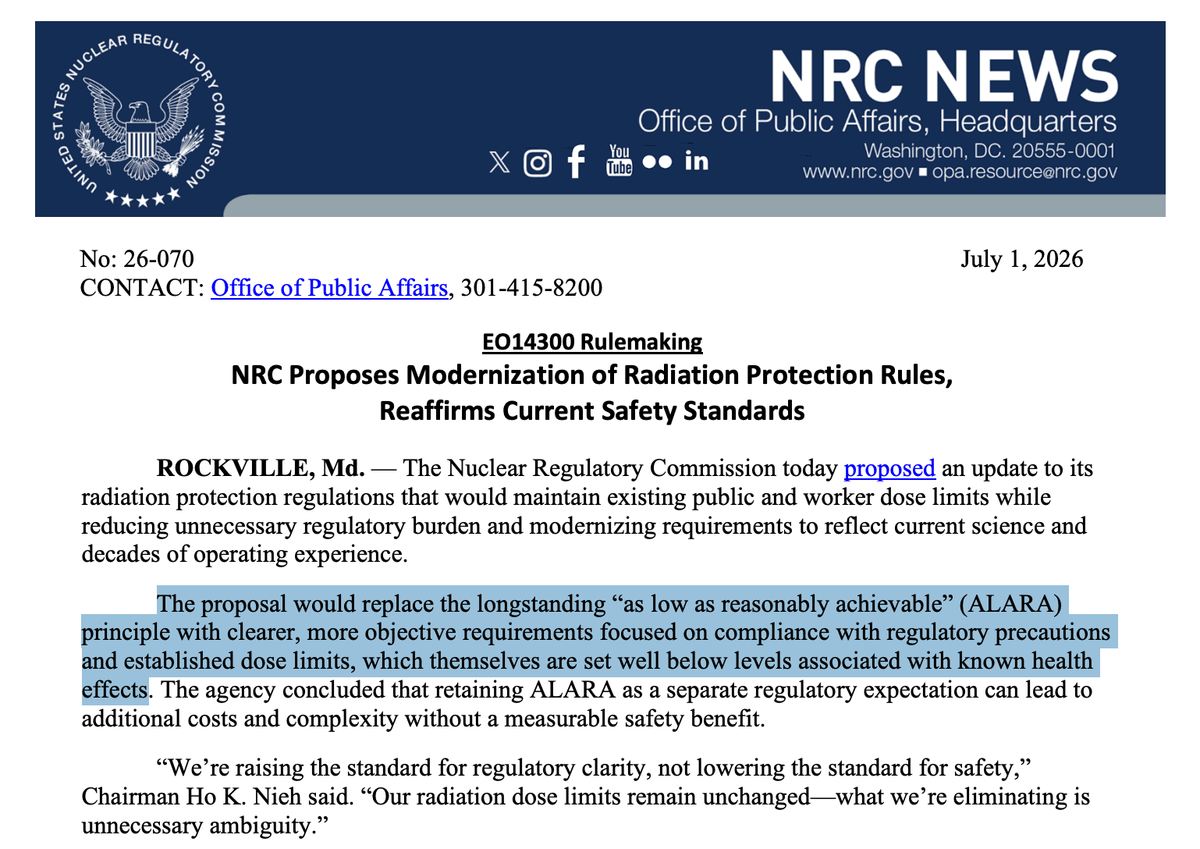
The NRC proposes replacing ALARA with a rule that lets operators weigh radiation reduction below the dose limit against the costs of achieving it.
This will save developers some money. But it preserves ALARA’s #1 problem: the premise, from LNT, that no radiation dose is safe.4
-
Replacing ALARA but keeping LNT
- Preserves the super-low radiation dose limit that makes nuclear catastrophically expensive
- Reinforces irrational fear of nuclear by conceding that no radiation dose is safe
- Preserves the justification and infrastructure for ALARA to return
-
The NRC estimates that its challenge of ALARA will save the nuclear industry around $9.5 million a year.
That is tiny compared to the savings that would come from rejecting LNT, which an analysis by the Breakthrough Institute estimates is in the $10s of billions through 2050.5
-
To unleash nuclear energy in this country, the NRC must reject not only ALARA but LNT.
This looks like:
- Raising the dose limit by up to 50x, a level science shows is still safe
- Dropping requirements to reduce radiation below that limit, where science shows no health benefit
Michelle Hung, Steffen Henne, and Daniil Gorbatenko contributed to this piece.
References
-
Ars Technica - NRC is (sort of) getting rid of “as low as reasonably achievable” standard↩
-
“ALARA (acronym for “as low as is reasonably achievable”) means making every reasonable effort to maintain exposures to radiation as far below the dose limits in this part as is practical consistent with the purpose for which the licensed activity is undertaken, taking into account the state of technology, the economics of improvements in relation to state of technology, the economics of improvements in relation to benefits to the public health and safety, and other societal and socioeconomic considerations, and in relation to utilization of nuclear energy and licensed materials in the public interest.
Federal Register - Title 10, Chapter I, Part 20—Standards for Protection Against Radiation↩ -
The US’s public exposure limit today is 1 mSv but there is no credible evidence that exposure below 100 mSv causes detectable harm in humans.
Breakthrough Institute - The Public Confidence Game↩ -
U.S. Nuclear Regulatory Commission - NRC Proposes Most Comprehensive Modernization of Reactor Licensing in Decades↩
-
Breakthrough Institute - Estimation of Cost Reductions From Risk Informed Radiation Standards↩