
Originally published: February 17, 2026
We hear constant claims that solar and wind are rapidly and cheaply replacing fossil fuel power; Storm Fern demonstrated this is 100% false
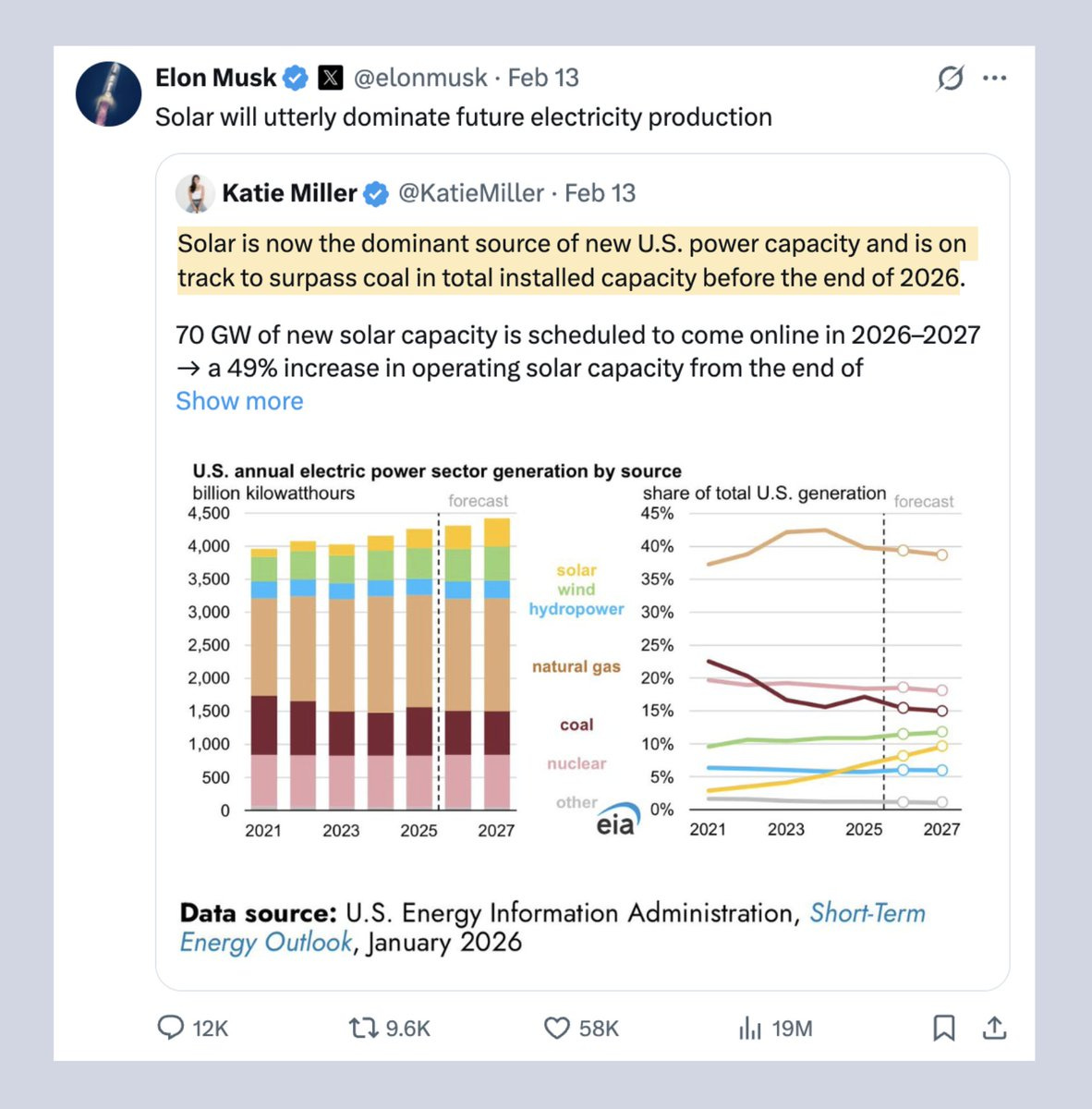
We’re bombarded with supposed examples of solar/wind rapidly and cheaply replacing fossil fuel power: rapid rises in solar/wind “capacity”1 or “generation”;2 solar/wind credited for supplying most of a day’s electricity;3 stats claiming solar/wind is now cheaper than fossil fuels.4
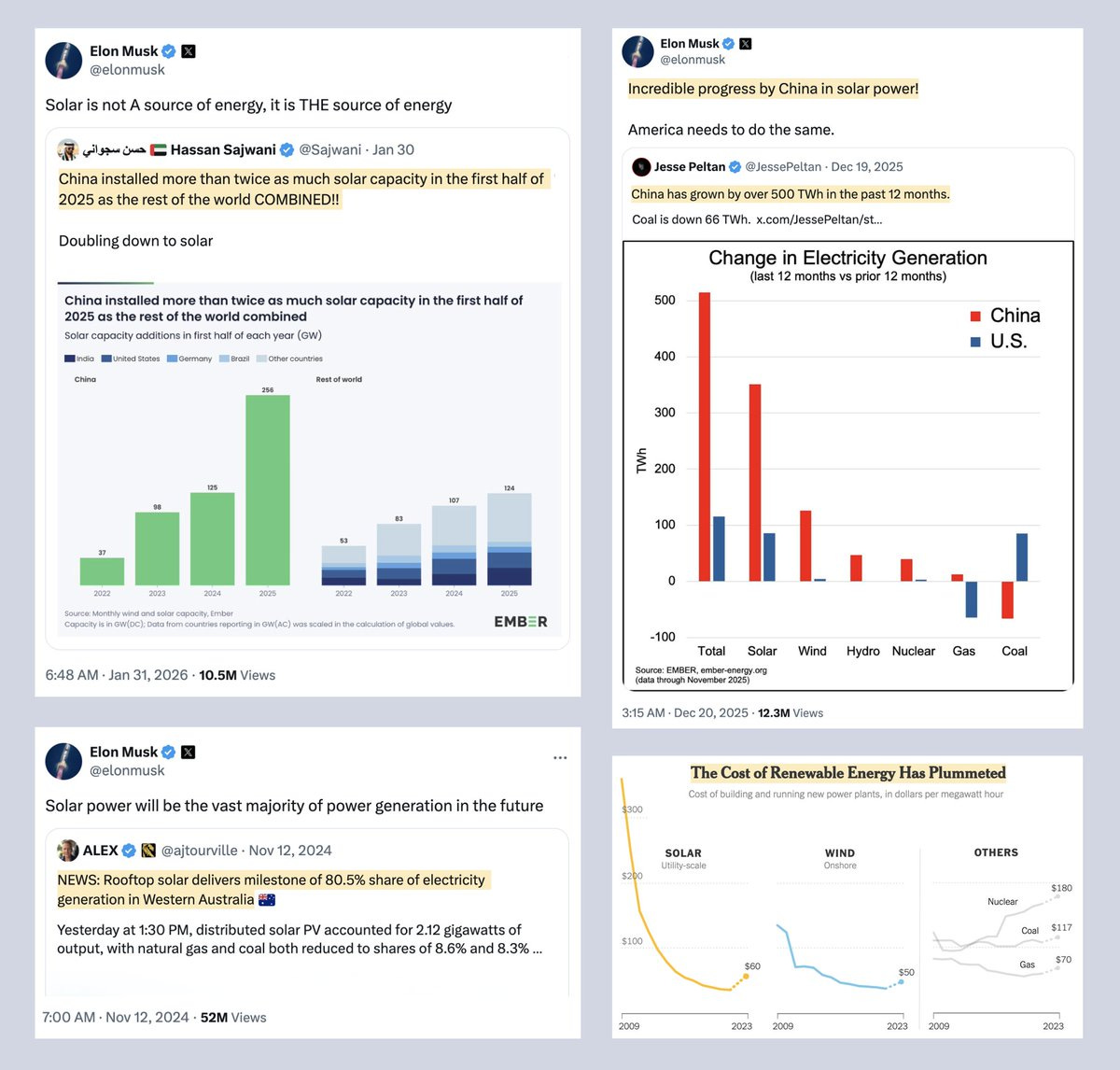
Advocates of solar and wind replacing fossil fuel power downplay the obvious, glaring problem that the grid requires electricity on-demand and that weather-determined, intermittent solar and wind can provide nothing resembling that. They either don’t mention intermittency or claim it’s easily addressed.
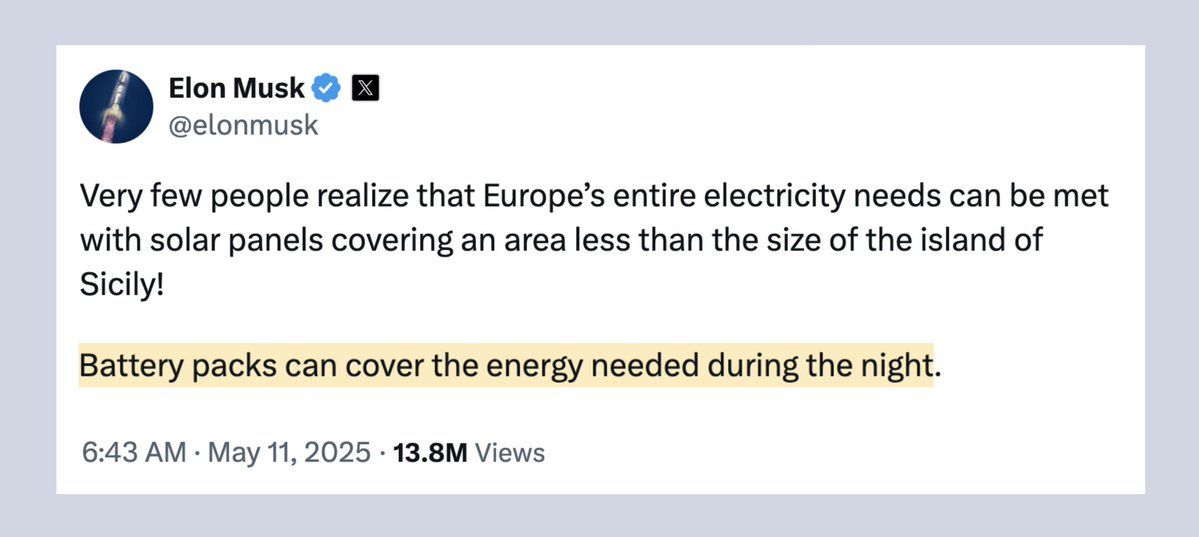
Take Elon Musk. He posts incessantly about solar replacing fossil fuels, and the vast majority of the time he doesn’t mention the intermittency at all! When he does he treats it as trivial, e.g., addressable by just storing excess daytime power in batteries and deploying it at night.5
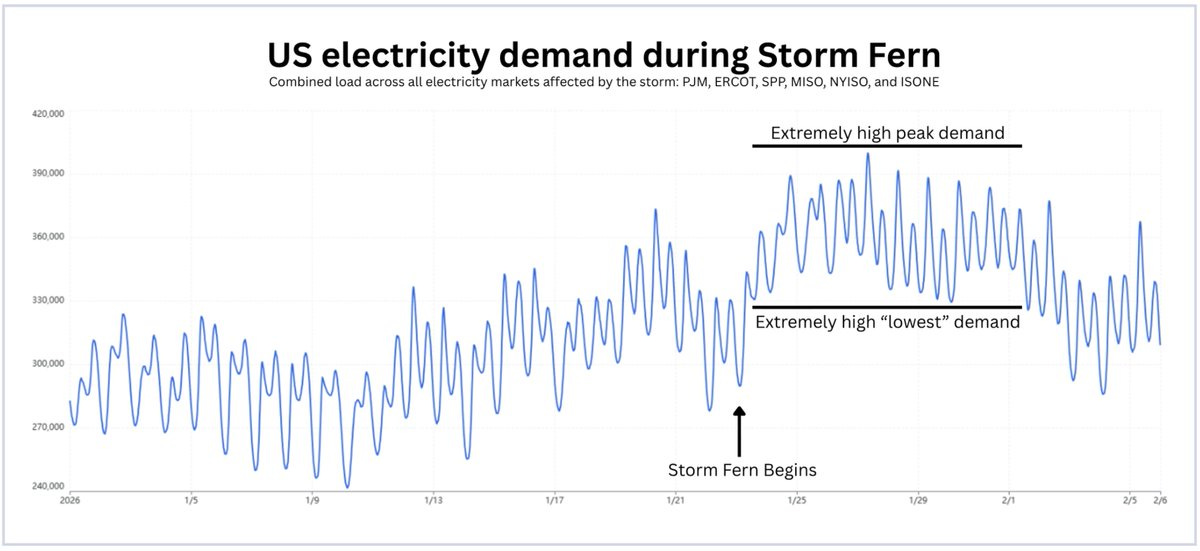
If you want to understand why intermittent solar and wind are not rapidly and cheaply replacing fossil fuel power, there is no better case study than their frequent disappearance during the high-demand week of Winter Storm Fern (1/23 to 1/31)—and the high costs this imposed on the public.
Solar/wind frequently disappeared during Storm Fern’s huge power demand, leaving Americans 100% reliant on our gutted reliable power sources
The electricity grid that our lives and prosperity depend on requires that power plants and their supporting infrastructure—pipelines, transmission lines, distribution lines—provide exactly as much supply of electricity as consumers demand. If our power plants can’t do this, the grid blacks out.
For any technology to replace fossil fuel power, in whole or in part, it needs to make a reliable contribution to providing the on-demand, all-the-time (24/7/365) power our grid needs to work. In technical terms, it needs to provide “capacity”—the ability to generate electricity as-needed. If a technology can’t reliably provide capacity then we still need the exact same amount of fossil fuel power infrastructure to meet demand.
Arguably, the single most important time for a power source to operate reliably is during winter storms, where demand is high, persistent, and existential. E.g., the cold from Storm Fern generated near-record winter demand throughout the country, causing a week-long period of extreme electricity consumption such that if the power went off many Americans would quickly freeze to death.6
We commonly hear about the impressive “capacity” growth of wind and solar.7 But this is a perversion of the proper meaning of “capacity.” For traditional, reliable power plants—nuclear, coal, gas, oil—“capacity” is the amount of electricity it can generate on-demand, when needed. For solar and wind, “capacity” is the maximum potential electricity it can generate when there are perfect weather conditions. Storm Fern showed how in real-world conditions, solar and wind’s “capacity” is an illusion.
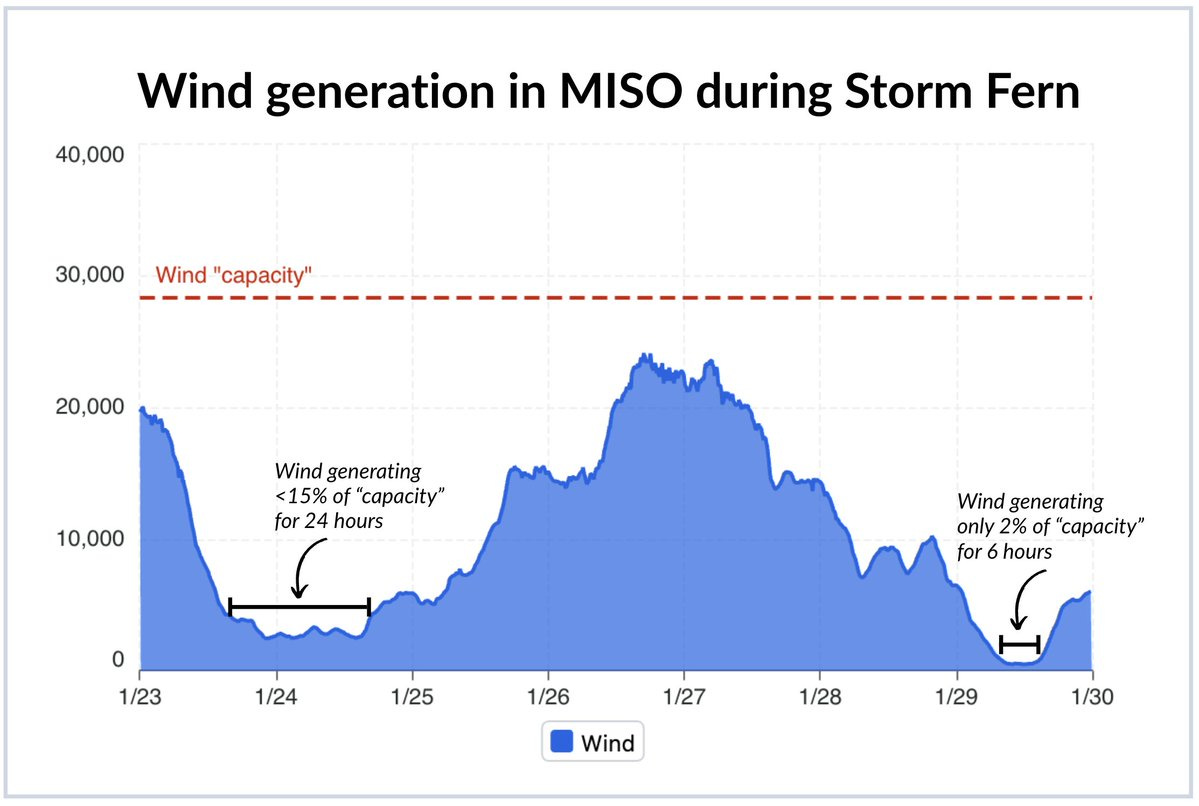
Wind frequently provided very little electricity at times of high demand during Storm Fern. For example, the Mid-Atlantic grid (“PJM”) and the Midwest grid (“MISO”) each had at least one morning of peak demand where wind performed at around (and sometimes lower than) 10% of its supposed “capacity.” And for a 6-hour mid-day period on 1/29 in MISO, wind provided only around 2% of its “capacity.”8
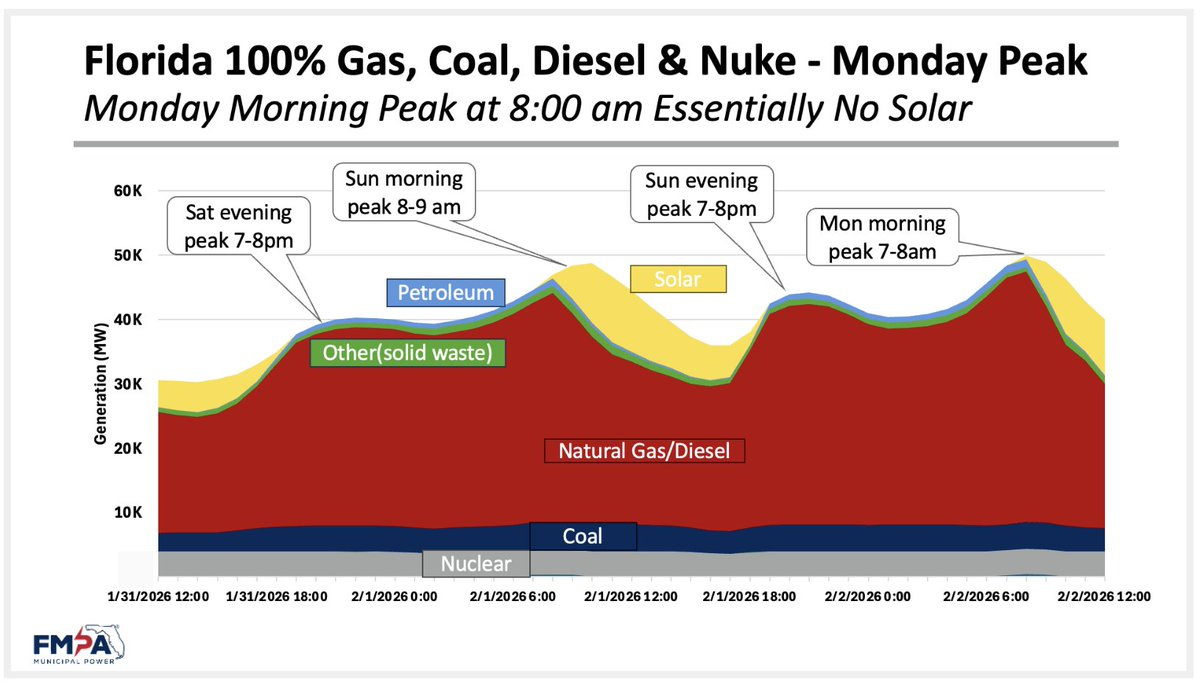
As badly as wind performed during Storm Fern, solar—which Elon Musk and his acolytes treat as infinitely superior to wind—performed far, far worse. As often happens during winter storms, solar was mostly or totally useless during the times of highest demand (evening and early morning).
Observe that in Florida, which was hit later than other states by Storm Fern’s cold, solar provided zero help during its intense evening peak demand on 1/31 and 2/1, barely any help during the morning peak of 2/1, and zero help during its highest demand time of all, the morning peak of 2/2. Solar’s real “capacity” was obviously zero.9
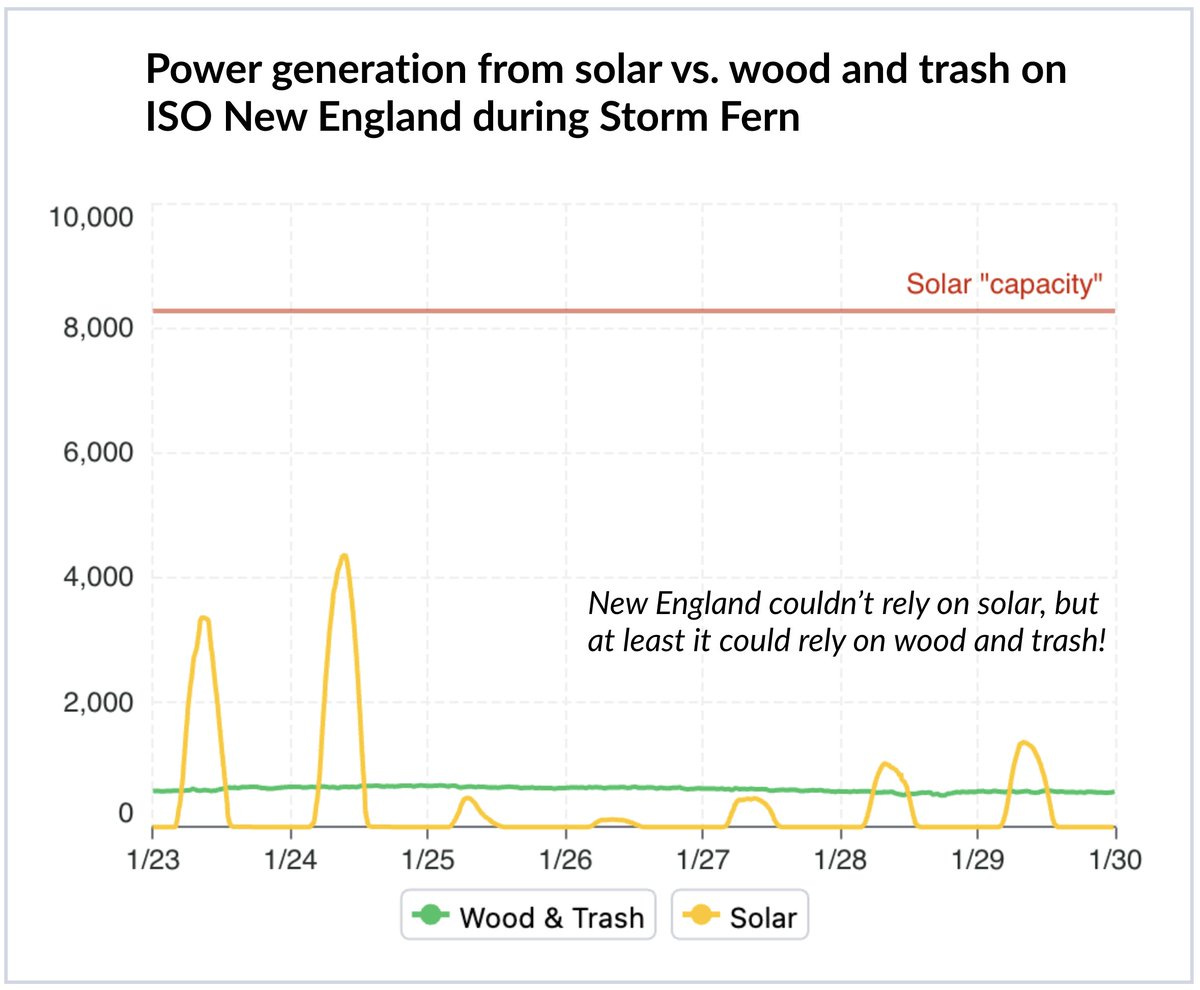
Not only did solar predictably disappear when needed most, during evenings and early mornings, it also underperformed during the day—meaning it could not reliably charge the batteries we are told are solar’s savior. Observe that in New England, solar performed far, far lower than its “capacity” for days on end, to the point that burning wood and trash often provided significantly more electricity than solar.10
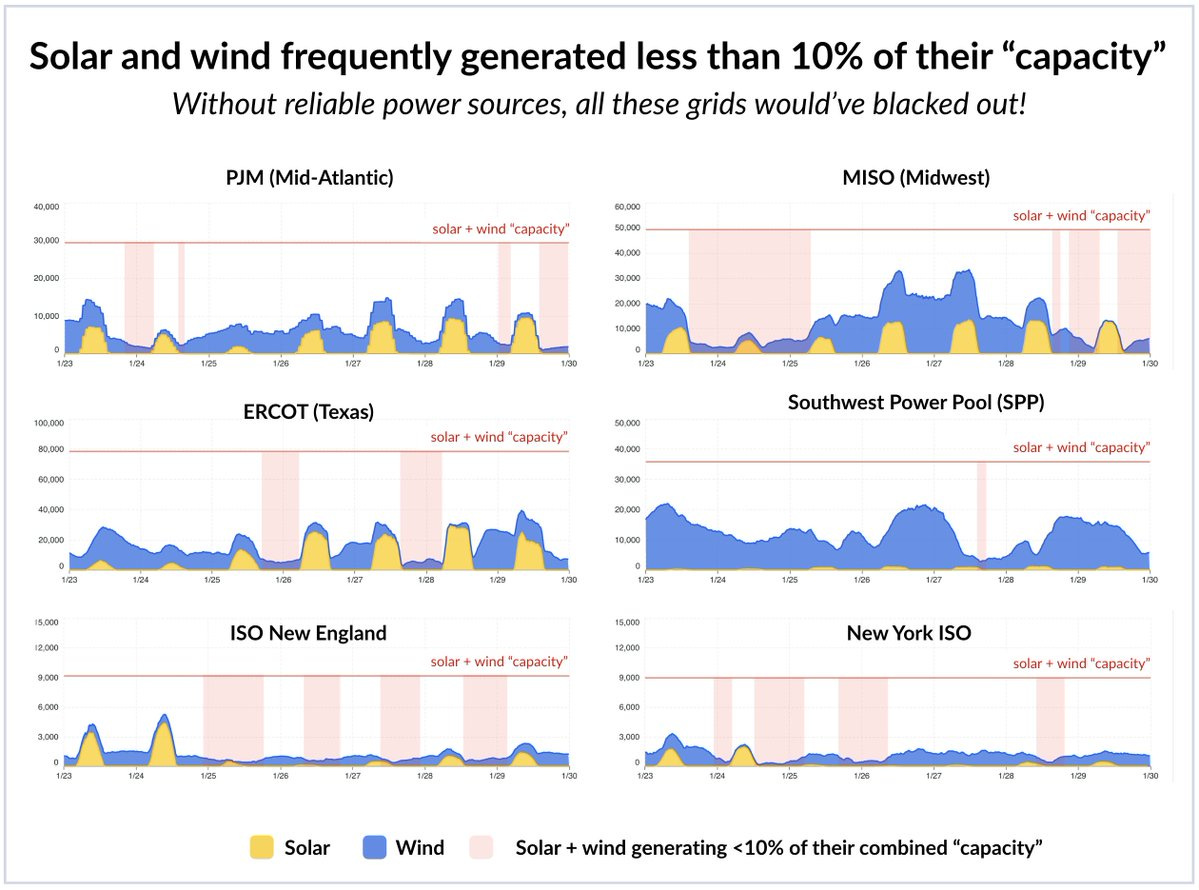
We are often told that if you combine solar and wind together, they’re somehow reliable. But this is not true, as Storm Fern painfully illustrated. For long stretches of time in most affected grids, solar/wind combined generated less than 10% of their supposed “capacity”—meaning that even together they couldn’t be relied upon to provide power or charge batteries.11
The only reason that the lights and heat stayed on around the country during Storm Fern is that we have, barely, kept enough reliable capacity to provide all the power when solar and wind disappear. But just barely, and at great cost, since the anti-fossil-fuel policies urged by solar/wind propagandists have reduced the supply of reliable power plants and supporting infrastructure.12
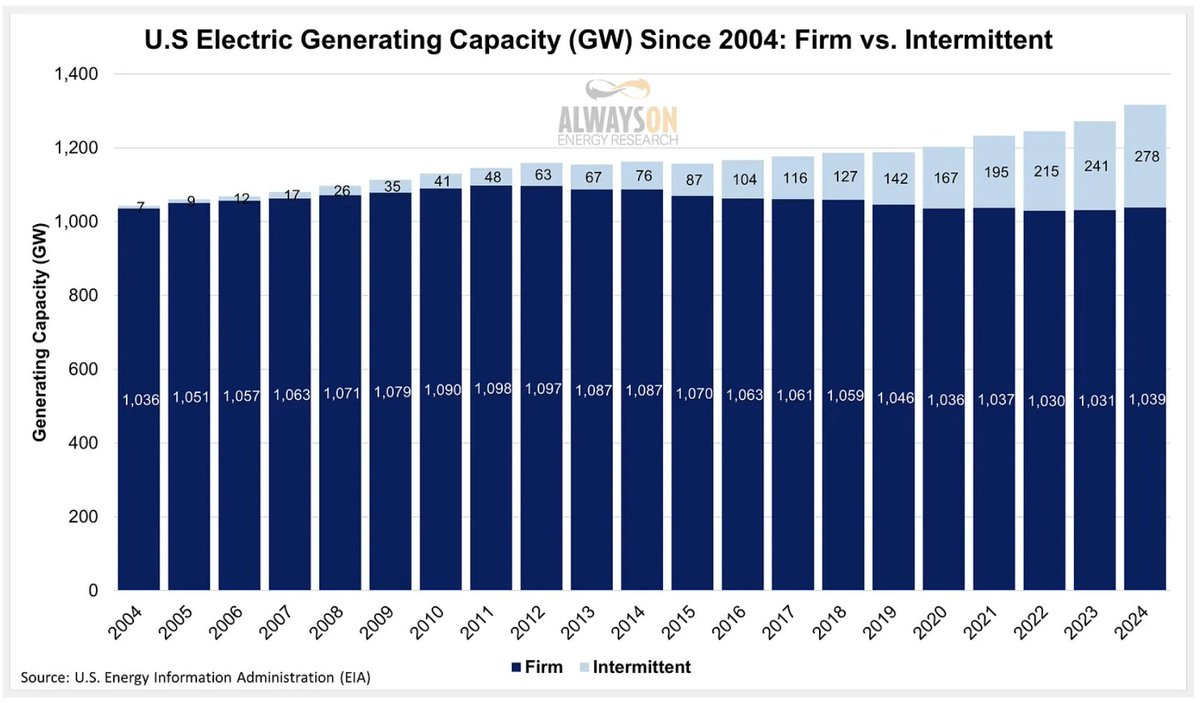
Had we not shut down so many coal plants and suppressed so many pipelines and prevented so many gas plants,13 Storm Fern’s demand could have been easily and cheaply met. Instead, it strained grids, spiked power prices, and spiked heating prices when solar/wind failed to deliver.14
Storm Fern was a perfect litmus test for purported replacements of fossil fuels. If a type of “power” or “capacity” cannot reliably contribute to preventing Americans from freezing to death during a week of nationwide cold weather, whatever else it is doing it is absolutely not replacing fossil fuels. Solar and wind failed that test.
Note that while we hear stories of various types of electricity struggling under winter storms, such as a natural gas line or plant failing, those struggles are not inherent in the technology like solar and wind’s struggles are. Fossil fuel power can be weatherized to provide reliable power from the coldest places on Earth (e.g., Antarctica) to the warmest (e.g., Saudi Arabia). The lack of sunlight and wind during winter storms (or summer nights during heat waves) cannot be fixed.
Because solar/wind can go to 0 and can underperform for long periods, they can’t reliably produce power or reliably charge batteries
When you see Elon Musk and others posting about the ability of solar to replace fossil fuel power, they are assuming solar (or wind), despite being intermittent and therefore unreliable, has “capacity value”—that it can be relied on to generate the on-demand power the grid requires, usually through the alleged magic of batteries. This is false.
Because solar and wind can go to zero at any given time, they clearly cannot replace any reliable capacity on their own. And because solar and wind can underperform for prolonged periods, they also can’t provide a reliable surplus to charge the batteries that can allegedly make them reliable!
While the benefits of batteries to provide spare capacity are usually attributed to solar/wind, the benefits of batteries actually depend on the reliable power provided by fossil fuel power and nuclear power—which can reliably charge batteries during off-peak hours.
Winter storms, which affect some 2/3 of the US, are one reason solar and wind can’t provide reliable capacity. But they are not the only reason. There are multiple ways solar and wind can disappear that affect the rest of the US, including prolonged rainstorms that sabotage solar generation in areas with limited wind potential.
In the Southeast there’s barely any wind, so wind turbines are rare in the first place. But there are plenty of tropical storms to wipe out most solar for a week. In sunny California, an atmospheric river or other precipitation event can wipe out most solar generation for a week or more, or cause a multi-day period where the output from both solar and wind is very low.
Even in sun-drenched Arizona, which you might think has reliable solar, we’ve seen that storms can render solar useless for prolonged periods. In January of 2010 a series of three low-pressure systems wiped out most of Arizona’s solar for 6 days!15 The bottom line: Weather fluctuations throughout the country are simply devastating for attempts at self-sufficient solar/wind/battery generation.16
The only way to make solar or wind reliable power sources is to pay so much for “overbuilding” and multi-day storage that it costs 10-20X gas power
The only way you can rely on just solar, wind, and batteries to provide on-demand, all-the-time electricity—is a combination of “overbuilding” and multi-day storage that would end up costing, in free-market conditions, 10-20X what a natural gas plant does!
Overbuilding: One way to partially compensate for solar and wind’s erratic performance is to build so much of them that even when their output is low (such as 1/10th its maximum potential) you still have enough power to meet demand—and plenty of surplus to charge batteries for when even your overbuilt solar and wind can’t meet demand (such as solar every night or when the wind almost totally dies down).
Overbuilding, even putting aside storage, is a huge expense. Every 10X you overbuild solar costs you $12,500/kW and wind costs you $13,200/kW, vs. the $1,000/kW natural gas power cost before anti-fossil-fuel policies created artificial shortages and drove the price to $2,400/kW.17
Multi-day storage: When you’re dealing with extended periods of suppressed output for solar and wind, even if you do a 10X overbuild you still need batteries to handle solar’s nights + multi-day disappearances and wind’s long lulls. Every day of battery storage costs about $6,000/kW, so for 3-7 days you’re talking $18,000-$42,000/kW (the higher part of the range is more realistic for solar).18
To see all this for yourself, ask any elite AI what it would take (and cost) for just solar, wind, and batteries (or just solar and batteries if you just like solar) to meet year-round demand, including winter peak demand, in a given region. This is the standard needed to provide real capacity that could truly replace fossil fuel capacity, whether you are talking about 1% or 100% of capacity. Here’s my prompting template.
-
What is the ideal mix of self-sufficient [solar+batteries OR wind+batteries OR solar/wind+ batteries] to meet year-round demand, including winter peak demand, in [region]?
Do not use any subsidies as part of your calculation, only use unsubsidized prices.
How much “overbuilding” of the intermittent generation is needed, and how much battery storage (measured in winter peak hourly demand * 24 hours) is needed?
The system must be able to handle the most adverse weather conditions (least favorable toward solar/wind generation) of the last 30 years, including the recent Storm Fern.
The system should have the standard 15% reserve margin. As part of your analysis, give me the cost of the system per KW of dispatchable capacity (peak demand plus the 15% reserve margin).
Here are queries from Gemini 3 Pro Deep Think,19 ChatGPT 5.2 Pro,20 and Grok 4 Heavy21 calculating the cost of just solar+batteries, since that is the scheme we are most prominently told is our savior, in the Mid-Atlantic (“PJM” region), which is the biggest grid in the US.
Gemini estimates that powering PJM on solar+batteries would cost $7.24 trillion in capital costs and $41,970/kW. ChatGPT estimates $5.70 trillion in capital costs and $33,300/kW. Grok estimates $4.09 trillion in capital costs and $23,700/kW. Compared to $1,000/kW for a natural gas plant! (Note: I generally find Grok, which is led by Elon Musk, to be the least objective AI about the limits of solar and batteries.)
To do a rough apples-to-apples cost comparison of natural gas vs. solar/wind/batteries, you also have to add
-
For natural gas: Maintenance and (most expensive) the net-present-value cost of the fuel for natural gas (maybe $2K/kW over 30 years without anti-fossil-fuel policies).22
-
For solar/wind/batteries: Full equipment replacements after 10-20 years if the batteries do the heavy lifting of balancing the grid with frequent cycling23 (at least $5K/kW, probably much more)—as well as transmission infrastructure (unless you want residential systems that cost at least 2-3X more if you take into account the lower efficiency per panel because of the suboptimal rooftop placement).24
Bottom line: Solar/wind/battery’s replacement and other costs over time will far outweigh the fuel cost of gas.
Any realistic estimate of the cost of self-sufficient solar/wind plus batteries is initially going to be at least 20X the free-market price of a natural gas plant, and the lifetime estimate is going to be at least 10X. Considerably worse if you’re just using solar, which totally disappears >1/2 the time and thus requires catastrophically large amounts of storage.
Because the lifetime cost of self-sufficient solar/wind/batteries, let alone the far more expensive solar/batteries, is well over 10X that of a gas plant, no one in reality is trying to build self-sufficient solar/wind/batteries. But many of our most influential energy commentators—including Elon Musk, arguably the most influential—are misrepresenting solar/wind/batteries as actually self-sufficient and therefore replacements for reliable power sources.
What about the supposedly “exponential” decline in wind turbine, solar panel, and battery prices? If you look at the full cost of wind, solar, and battery systems there is nothing on the horizon that will make them remotely plausible as standalone power sources.
For wind turbines, there is no longer anything resembling an exponential price decline.25 Solar panels will likely continue to decline in price—how fast is unclear—but panels are now only about 15-30% of a solar project’s costs; the rest are materials, structures, and labor needed to make a project work, and these won’t decline anywhere near exponentially.26
Batteries will likely continue to decline in price—which is great for many applications, including the reliable storage of reliable electricity sources. Most of the cost drops will be in the battery cells themselves, although those drops will be limited by the costs of the mined materials involved.27 As with solar there are significant other materials, structures, and labor to make a system work that won’t rapidly go down in price. Thus standalone solar/wind/battery capacity remains a remote fantasy.
Solar and wind shouldn’t be thought of as reliable power sources, but rather intermittent fuel-savers for reliable power sources
If solar and wind are not replacements for fossil fuel power, what are they? After all, they are doing something—witness charts showing large amounts of “generation” in a day or the largest growth in “generation” and “capacity” over time.28 That “something” is saving fuel for reliable power sources.
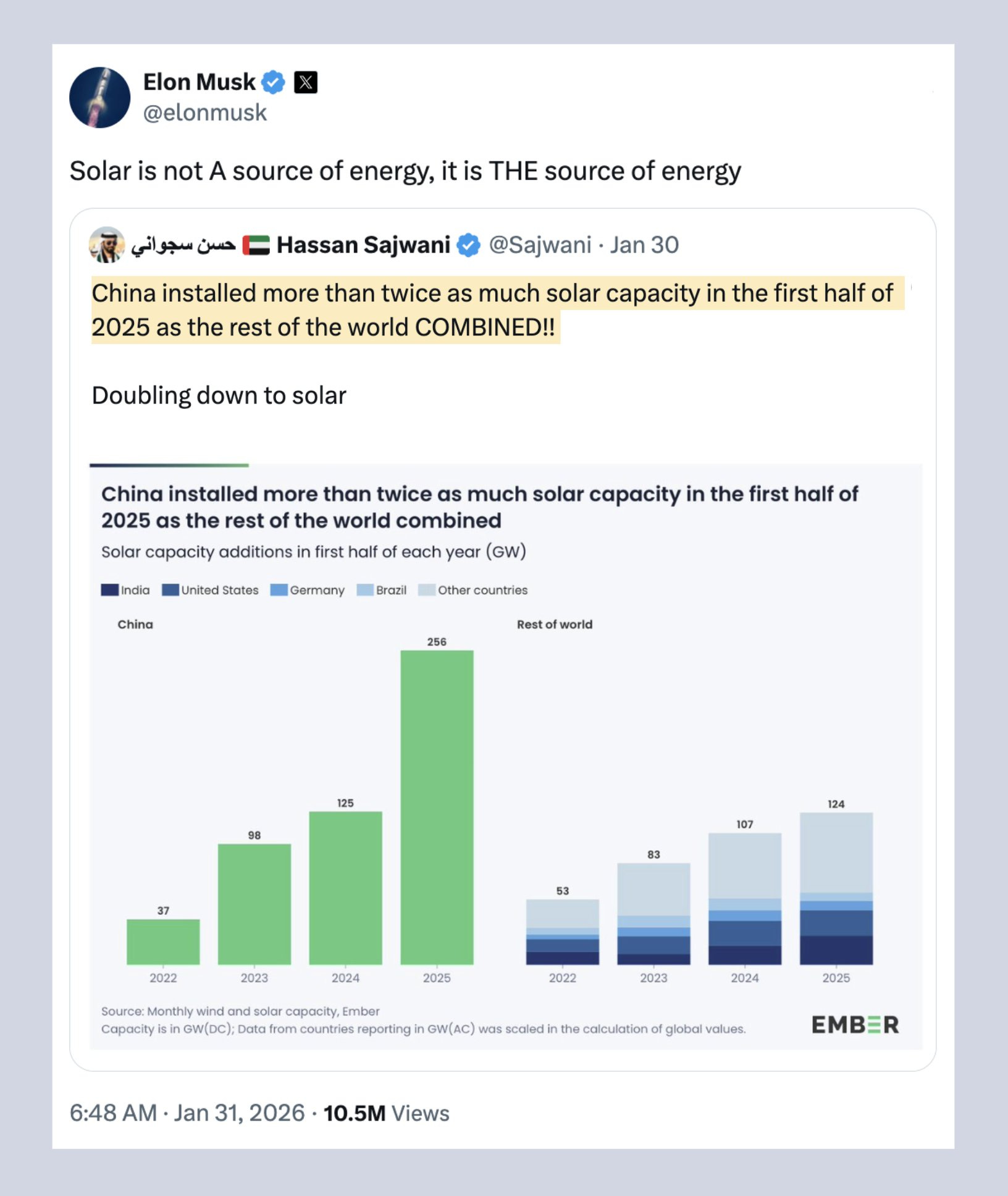
Any grid, to be responsible, needs an amount of reliable, on-demand power that exceeds by a comfortable margin (a “reserve margin”) its expected “peak demand.” Solar and wind cannot provide this reliable power. But they can save reliable power fuel whenever and to whatever extent there is sunshine and wind.
Once we properly categorize solar and wind as fuel-saving devices, we can start to rationally think about the cost vs. benefit of using them.
It is beneficial to use solar and wind when
[fuel savings] > [intermittent infrastructure cost] (with high upfront financing cost) + [reliable infrastructure deterioration].
-
[fuel savings]: The fuel savings of solar/wind is [fuel burn avoided] - [fuel inefficiency].
-
[fuel burn avoided] is the total dollar value of natural gas (or other fuel) one avoids burning.
-
[fuel inefficiency] is the fuel efficiency lost from rapidly cycling up and down natural gas and coal plants to accommodate solar, which loses fuel via fuel inefficiency, just as stop-and-go traffic does.
-
[intermittent infrastructure cost] is the cost of solar panels and wind turbines plus the cost of long-distance, high-voltage transmission lines to bring faraway, erratic solar/wind to population centers, plus the cost of local distribution equipment (e.g., to put residential solar on the grid).
-
(high upfront financing cost) is the added cost involved when you’re paying for fuel savings, which occur slowly over time, through a very large upfront payment for solar, wind, and batteries that must be financed at current interest rates.
-
[reliable infrastructure deterioration] is the significant deterioration cost imposed on natural gas or coal infrastructure, which performs best when operated in a stable, steady way and deteriorates much more quickly when operated erratically to accommodate the intermittent nature of sunlight and wind. (In the same way your car’s fuel economy goes down in stop-and-go traffic.)
While solar and wind, as intermittent fuel-savers, provide a certain kind of value in saving fuel, it’s important to note that in the vast majority of cases so far the cost of those fuel savings has far, far exceeded the value of the savings—which is a big reason our cost of electricity (including the cost we pay in taxes/inflation for subsidies) is going up.
In practice, solar/wind’s fuel savings are almost always dwarfed by their huge infrastructure costs—which, along with restrictions on fossil fuels, have increased prices
If you ask state-of-the-art AIs (e.g., Gemini 3 Pro Deep Think,29 ChatGPT 5.2 Pro,30 Grok 4 Heavy),31 they will have trouble finding cases in the US where solar or wind has made economic sense. (The best cases are where anti-fossil-fuel policies have artificially inflated natural gas costs, which is an argument against those policies.)
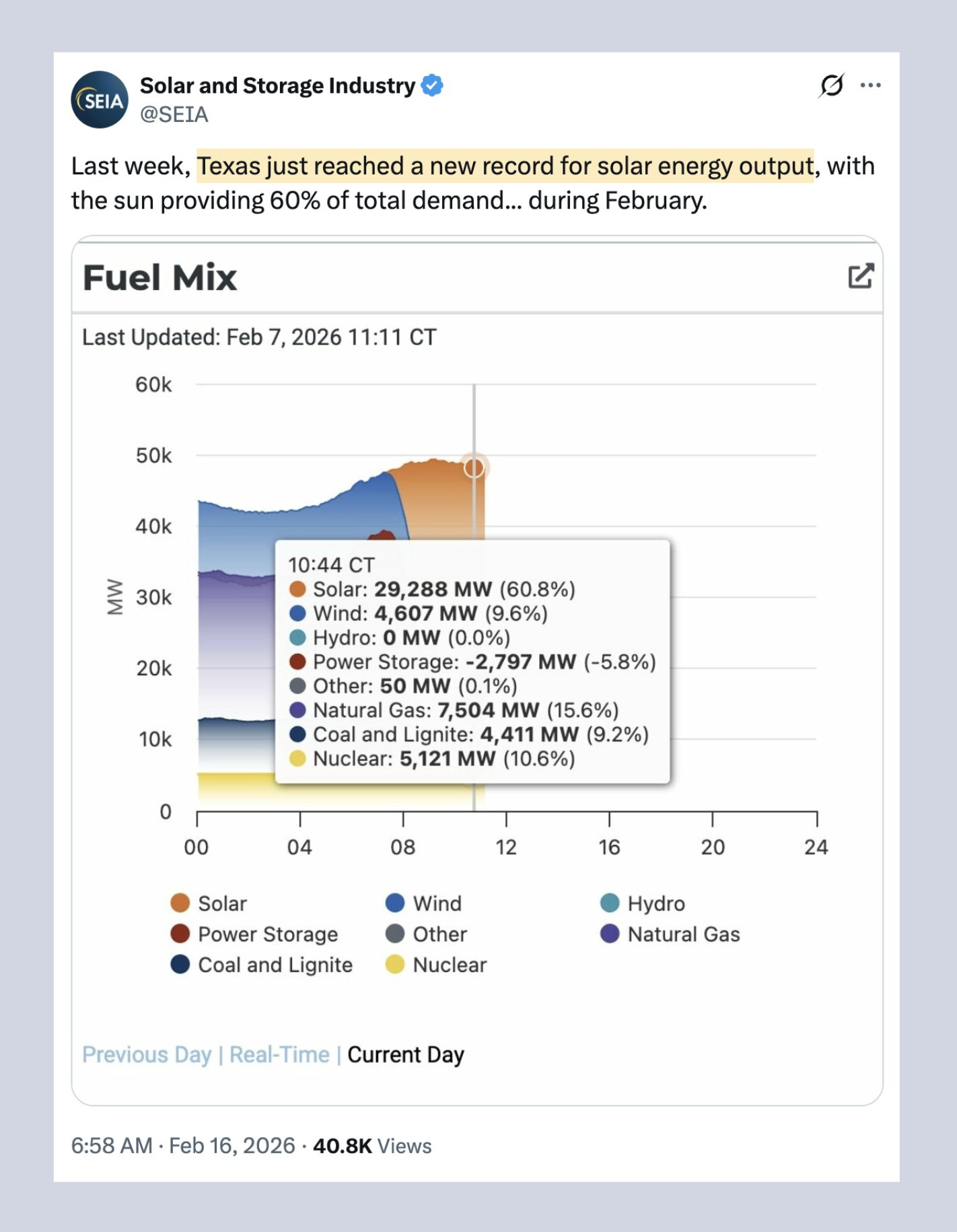
Let’s pause on this: even though solar and wind theoretically have value as intermittent fuel-savers, the hundreds of billions spent on them in the US so far have mostly amounted to burning other people’s money and have created no economic value whatsoever. Think about that when you see a chart celebrating rising solar “generation” or “output,” i.e., fuel savings.32
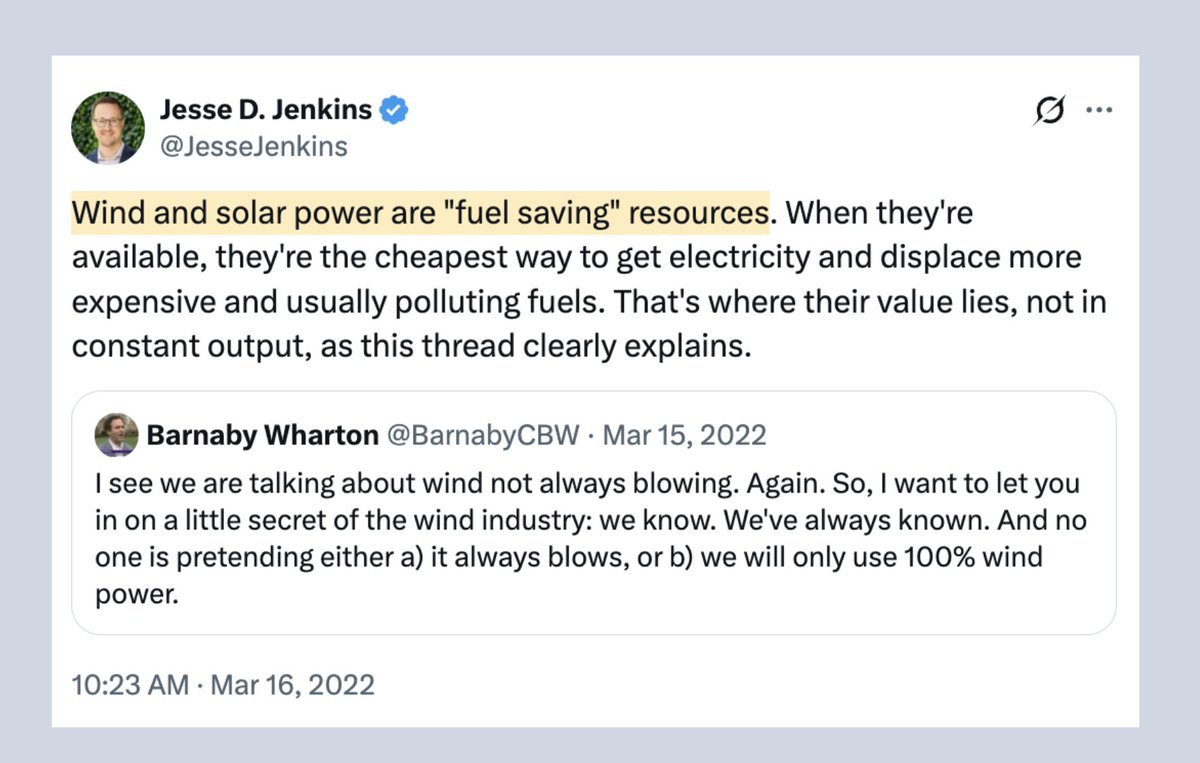
Note that many leading opponents of fossil fuels know that solar/wind are not reliable power sources but intermittent fuel-savers—they just believe that, for “climate” reasons, it’s valuable to spend a lot of money saving fuel since in doing so you reduce emissions from the fuel. That’s an intellectually coherent view, but it’s not honest to pretend their goal is to lower costs and that their policies haven’t raised costs.33
If we recognize that almost the entire solar/wind infrastructure and reliable capacity deterioration costs have not been remotely offset by fuel savings and have amounted to just burning money (often in the form of subsidies) we start to see why electricity prices have gone up when declining prices of natural gas—the grid’s number one fuel source—should have driven them down.34
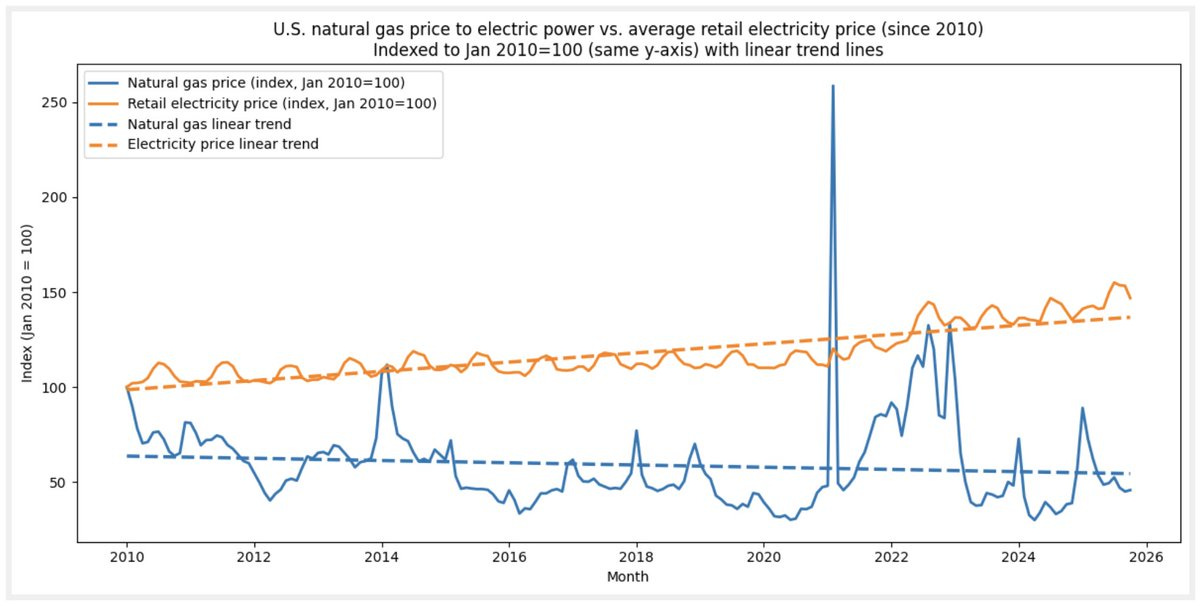
The other big reason electricity prices have gone up is that, in large part due to “solar and wind can replace fossil fuels” propaganda, the government has destroyed, disallowed, and discouraged fossil fuel power, massively driving up the cost of reliable power.
Reliable power shortages forced grids to operate close to their limits during Storm Fern, which increased wholesale electricity prices and will lead to significantly higher electricity bills for tens of millions of households in the near future. Lack of gas pipelines means that in a country with endless natural gas we’ll have regions like New England with sky-high gas bills.35
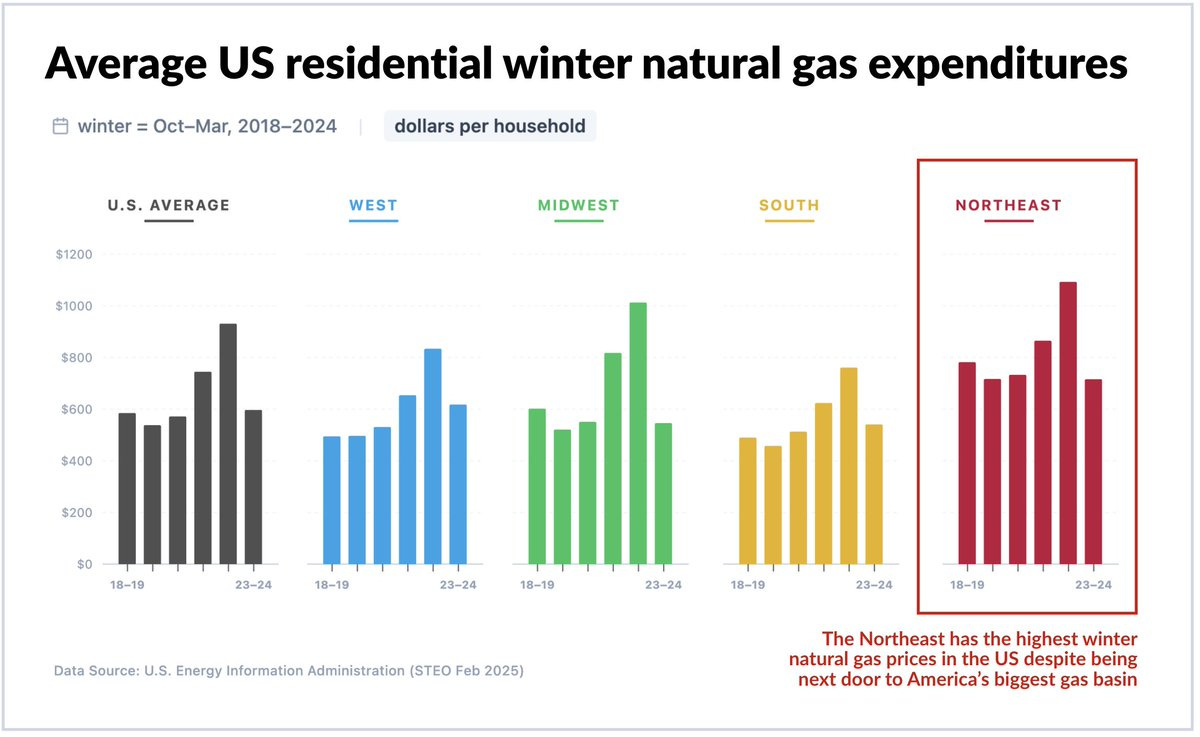
Bottom line: solar and wind “power” have not at all replaced fossil fuel power, but they have made power more expensive. And the idea that solar and wind are replacements, and thus that it’s costless to punish reliable fossil fuel power, has made power more expensive to an even greater degree.36
All energy discussions, analyses, and policy-making must totally stop treating solar and wind as reliable power sources and instead treat them as intermittent fuel-savers
Solar and wind shouldn’t be referred to as “capacity” or even “power,” but rather as what they really are: at best, intermittent fuel-savers (that are usually a big waste of money).
Solar and wind must never be spoken of as replacements or alternatives to fossil fuels as long as their intermittency issues are not solved at their own expense. As Storm Fern demonstrated, they do not, and cannot, power our grids, and pretending that they can was a major factor in creating today’s reliable power shortage.
When you see a country’s amount or percentage of solar/wind “generation” going up quickly—know that the same amount of reliable power capacity is needed, you’re just seeing a decrease in fuel use.37
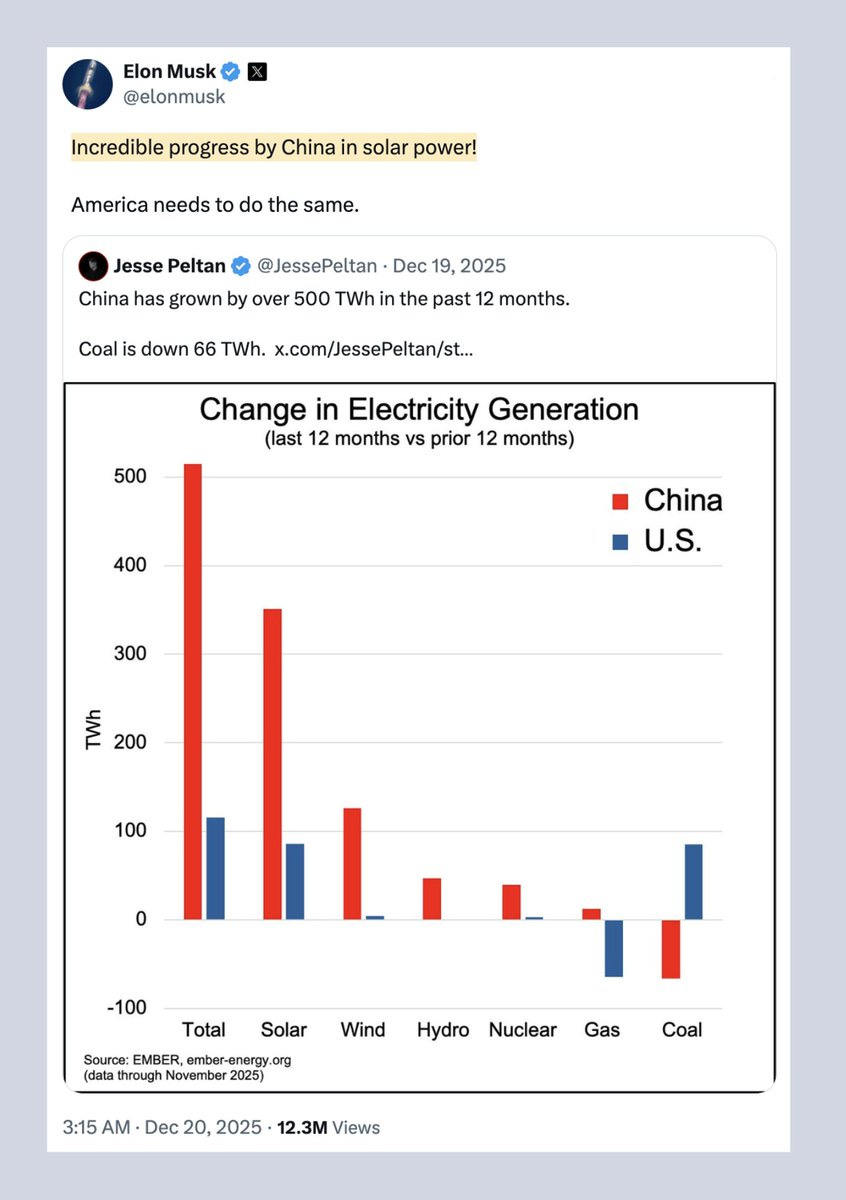
When you see a country’s amount or percentage of solar/wind “capacity” going up—know that it’s not real, reliable, on-demand capacity, it’s the peak momentary fuel savings possible for a weather-determined device.38
When you see a day in which a large percentage of a state or country’s electricity is labeled “solar” or “wind”—know that the same amount of reliable, on-demand power plant capacity is needed, you’re just seeing a decrease in fuel use that day.39
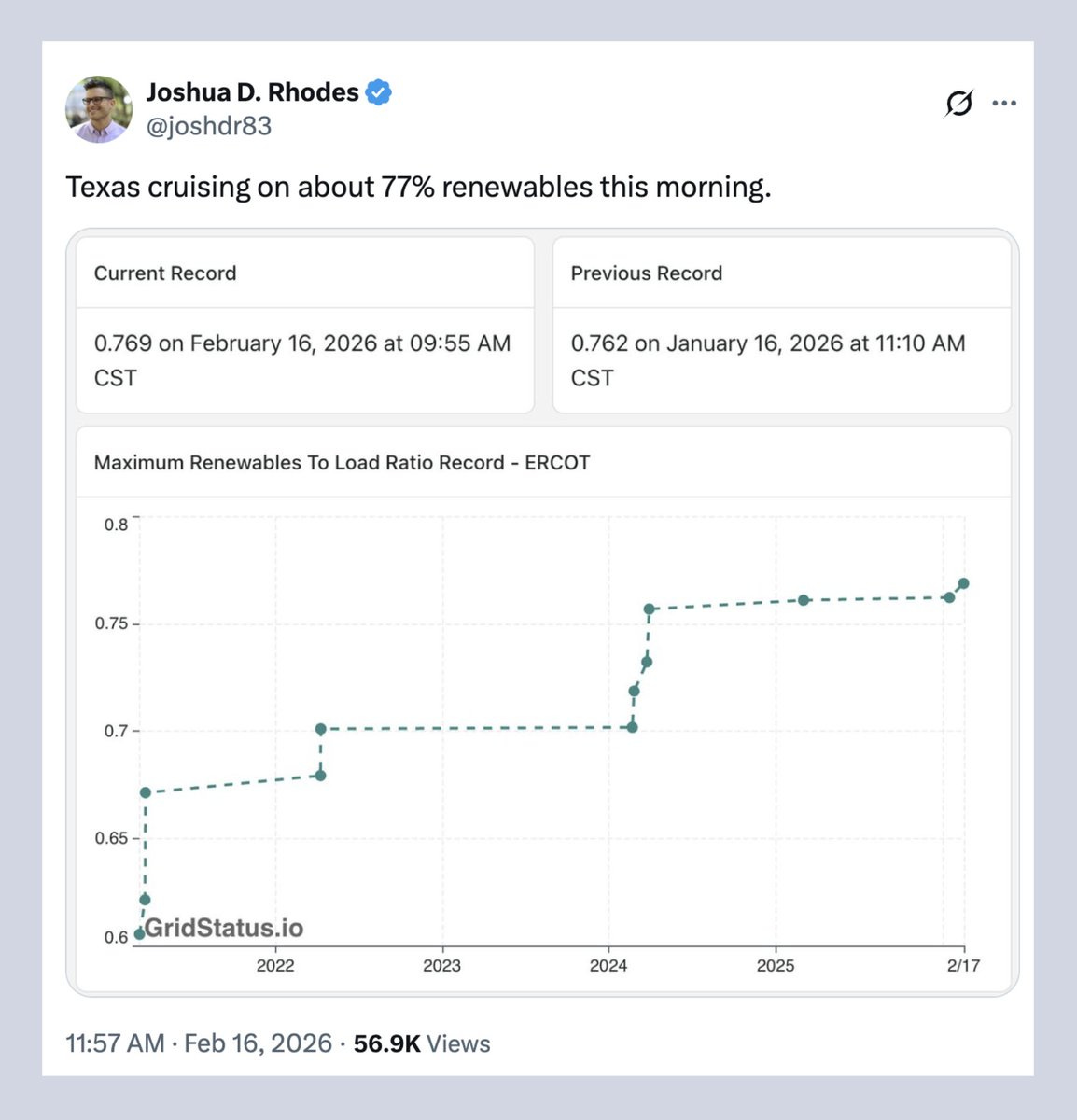
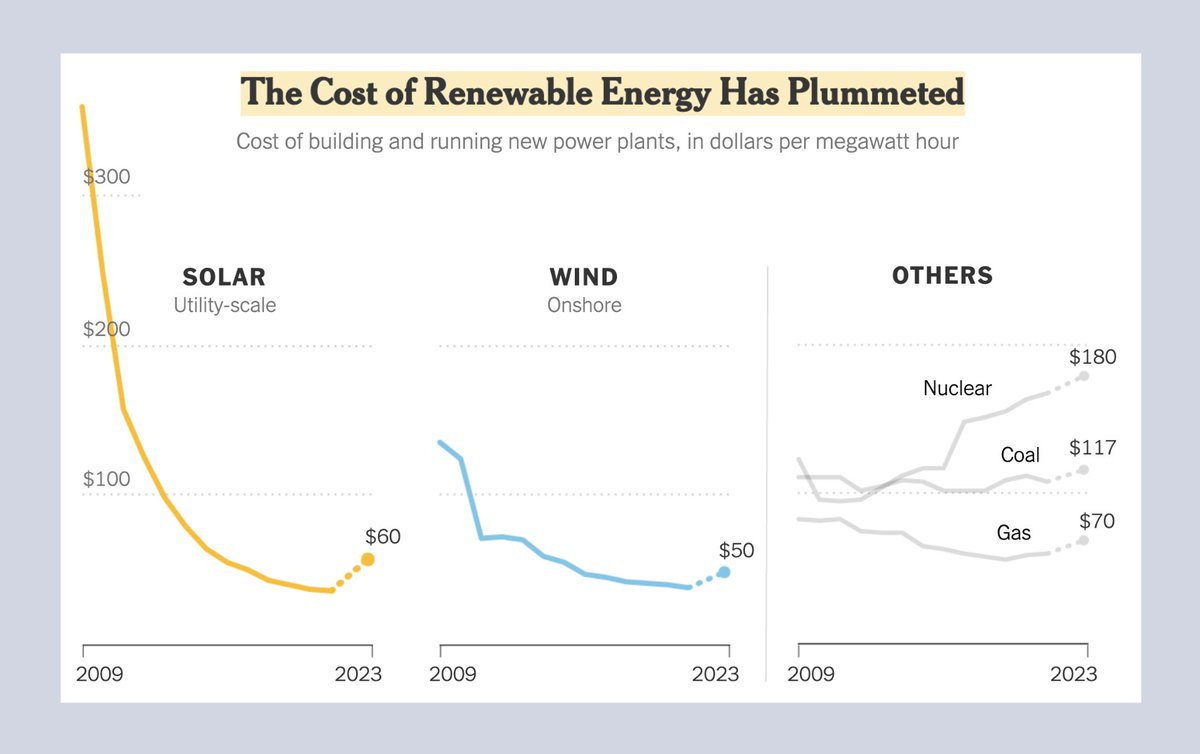
When you see the cost of solar and/or wind power is shown on a chart as lower than the cost of fossil fuels or nuclear power—know that you’re seeing an accounting fraud, because the cost of an intermittent fuel-saving device is paid on top of the cost of an on-demand power source, not instead of it.40
When you see that a new solar and wind project is said to “power” some large number of homes or factories or data centers—know that the solar and wind are “powering” nothing by themselves, since they are entirely dependent on on-demand power sources. Better to think of them as “coalar” (coal+solar) or “golar” (gas+solar) or “cwind” (coal + wind) or “gwind” (gas + wind).41
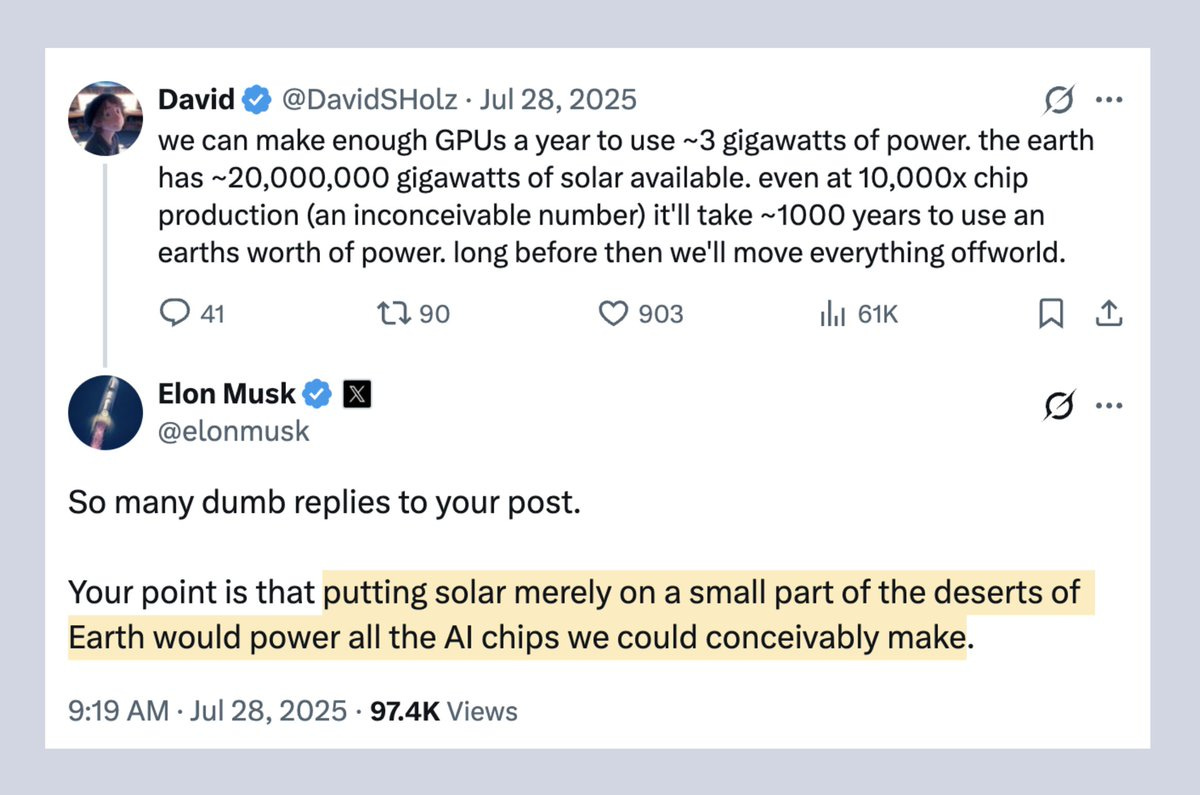
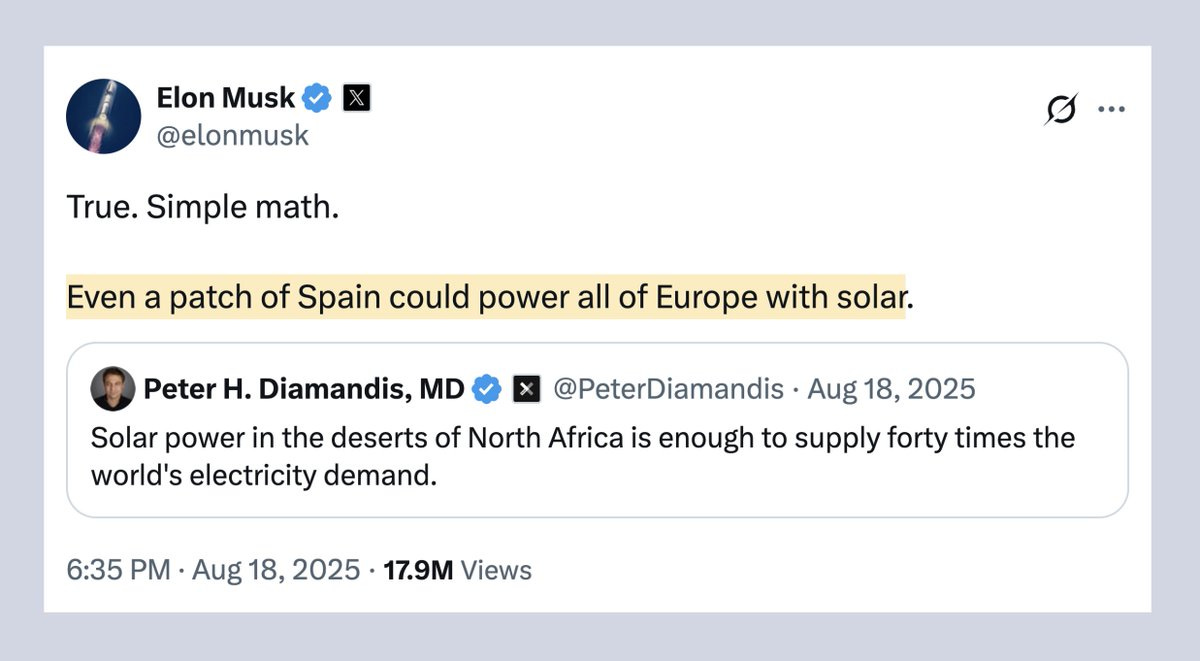
When you see that solar/wind power on a certain percentage of the Earth’s surface is said to be sufficient to power the world many times over—know that this is nonsense because the power is not on-demand and we need on-demand power.42
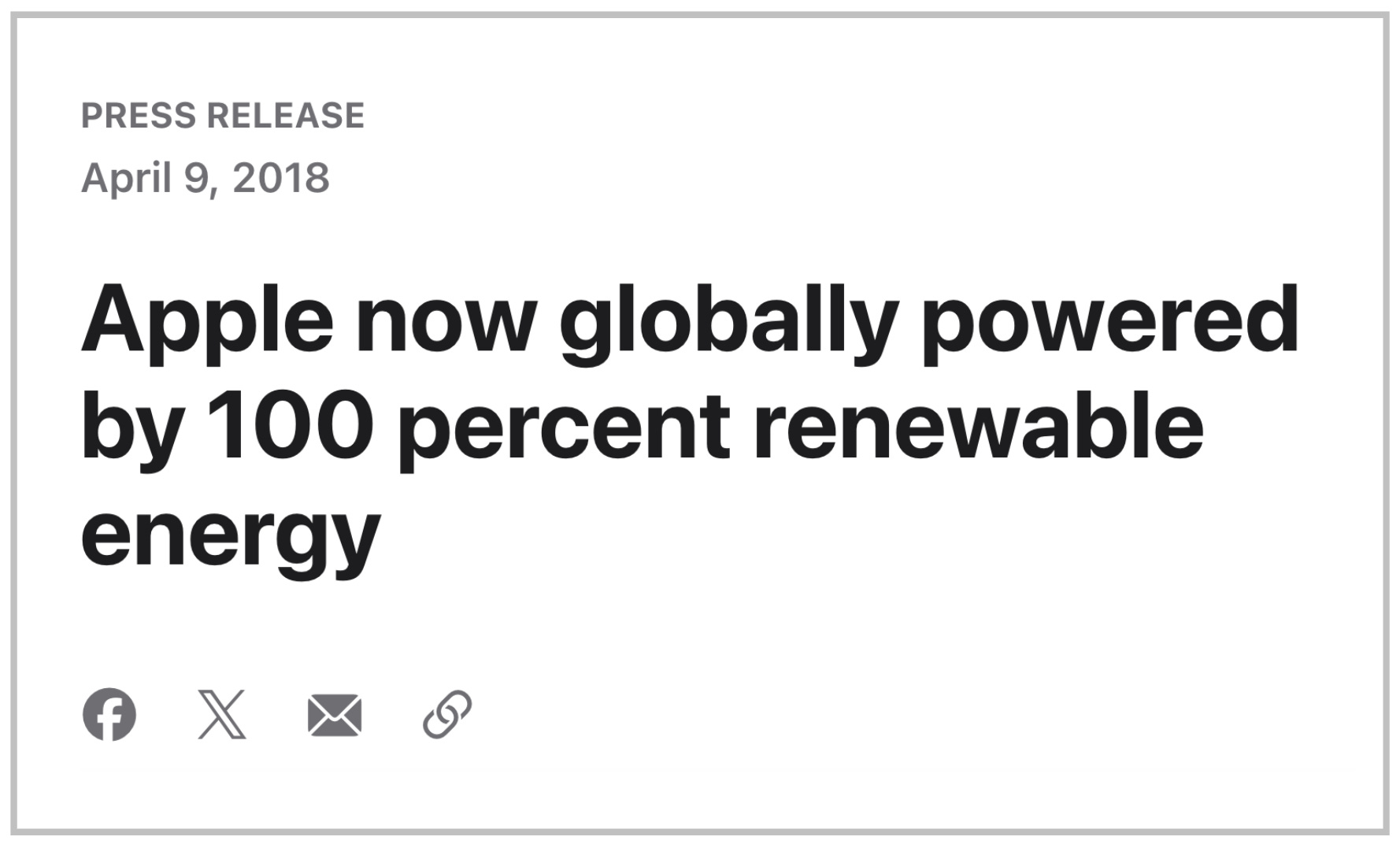
When you see that companies claim to be “powered by 100% renewable energy,” know that they are actually powered by reliable, on-demand power sources, but they are using accounting fraud to take credit for the intermittent fuel savings of others.43
To my economist friends and grid operators: start doing solar/wind cost analysis in terms of whether they are a cost-effective or cost-ineffective fuel-saving measure. That’ll lead to good decisions. Nothing good comes from pretending that solar and wind are real, reliable power sources.
The practice of intermittent fuel-savers siphoning away operating revenue from the reliable plants they are parasitic on must end. The grid needs to recognize that solar/wind have zero capacity value and thus those selling solar/wind generation should justly only get paid for the value of the fuel savings they provide. In a future piece, I will suggest some specific ways to put this truth into practice, but the first step is recognizing it.
I hope that this piece starts to bring an end to the rampant and ruinous dishonesty involved in pretending that solar and wind are rapidly and cheaply replacing fossil fuel power when they are, in fact, intermittent and usually economically wasteful fuel-savers. Only by starting with the truth can we make electricity cheap and reliable again.
Itamar Feldman, Daniil Gorbatenko, Steffen Henne, and Michelle Hung contributed to this piece.
References
-
New York Times - The Clean Energy Future Is Arriving Faster Than You Think↩
-
GridStatus.io, data from Independent System Operators, Regional Transmission Organizations, and the U.S. Energy Information Administration↩
-
GridStatus.io, data from Midcontinent Independent System Operator (MISO)↩
-
Florida Municipal Power Agency, data from U.S. Energy Information Administration - Hourly Electric Grid Monitor↩
-
GridStatus.io, data from Independent System Operator New England (ISO-NE)↩
-
GridStatus.io, data from Independent System Operator New England (ISO-NE), New York Independent System Operator (NYISO), Midcontinent Independent System Operator (MISO), Electric Reliability Council of Texas (ERCOT), Southwest Power Pool (SPP), PJM Interconnection (PJM)↩
-
Mitch Rolling and Isaac Orr - Watt, Me Worry? Record-Setting "Capacity" Can't Keep the Lights On↩
-
Alex Epstein - America’s energy crisis is mostly US Democrats’ fault
U.S. Energy Information Administration - Planned retirements of U.S. coal-fired electric-generating capacity to increase in 2025↩
-
Isaac Orr and Mitch Rolling - The Renewable IN-FERN-O
The Wall Street Journal - U.S. Cold Snap Kills Dozens and Leaves Thousands Without Power↩
-
U.S. National Weather Service - January 2010 Historic Winter Storm↩
-
PNNL - Energy Droughts” in Wind and Solar Can Last Nearly a Week, Research Shows↩
-
SEIA. - Solar Market Insight Report Q3 2025. NREL recently estimated the capital cost of 1 watt of solar at $1.253 per watt for single-axis tracking panels, which means $12,500 per kW.
Berkeley Lab - Land-based wind market report, 2024 edition. LBL recently reported the capital cost per kW for lowest cost wind projects at $1,320 per kW. NREL recently estimated the capital cost of 1 watt of wind at $1.5, which means $15,000 per kW.
Lazard. LCOE+ 2023. In 2023, Lazard estimated the capital cost of natural gas combined cycle plants at $650-1300 per kW, the mean for which is $975.
S&P Global. US gas-fired turbine wait times as much as seven years; costs up sharply↩
-
NREL. Cost Projections for Utility-Scale Battery Storage: 2025 Update. NREL estimated the capital cost of 1 kWh of 4h storage systems at around $300 per kWh, which means $1200 per kW for 4h endurance. Scaling to 24h per day gives $7200.
(While this reference puts battery storage costs at $7,200/day, I am using the more optimistic number of $6,000/day which some projects today claim to be achieving.)↩
-
Gemini 3 Pro Deep Think - “What is the ideal mix of self-sufficient solar+batteries to meet year-round demand, including winter peak demand, in PJM?...”↩
-
ChatGPT 5.2 Pro - “What is the ideal mix of self-sufficient solar+batteries to meet year-round demand, including winter peak demand, in PJM?...”↩
-
Grok 4 Heavy - “What is the ideal mix of self-sufficient solar+batteries to meet year-round demand, including winter peak demand, in PJM?...”↩
-
U.S. Energy Information Administration - U.S. Natural Gas Electric Power Price. Assumptions:
-
Long-term natural gas prices for electric power generation are $3 per thousand cubic feet (≈MMBtu).
-
Average utilization (capacity factor) of 60% for a combined cycle turbine.
1 kW with capacity factor at 60% produces 5.256 MWh/yr, requiring 39.67 MMBtu/yr worth of natural gas.
-
Annuity factor of 5% for 30 years
-
→ $1,829.58 per kW capacity
-
-
Lars Schernikau - The Battery Storage Delusion: Utility-Scale Batteries Are No Silver Bullet↩
-
U.S. Department of Energy - Solar Photovoltaic System Cost Benchmarks↩
-
Mark P. Mills - The “Energy Transition” Delusion A Reality Reset
National Renewable Energy Laboratory - Cost Projections for Utility-Scale Battery Storage: 2025 Update↩
-
Gemini 3 Pro Deep Think - “...in what circumstances if any is it economic to use solar?...”↩
-
ChatGPT 5.2 Pro - “...in what circumstances if any is it economic to use solar?...”↩
-
Grok 4 Heavy - “...in what circumstances if any is it economic to use solar?...”↩
-
U.S. Energy Information Administration - Average retail price of electricity / all sectors
U.S. Energy Information Administration - U.S. Natural Gas Electric Power Price↩
-
Reuters - Power plant outages surge in Eastern US amid restricted gas supplies and frigid weather
Kerry Clapp. New England ISO: A Self-Inflicted Energy Crisis
-
The only exception to the point that solar/wind aren’t really capacity is that there are supply-flexible consumers that are truly okay with only getting energy when the sun shines, the wind blows, and/or with whatever batteries have stored from previous solar/wind.
Insofar as there are supply-flexible consumers so non-demanding that solar/wind/batteries alone can accommodate them—which so far has proven rare—then those loads should create private or quasi-private generation for this “capacity” so it doesn’t affect reliable, on-demand power for the rest of us.↩
-
New York Times - The Clean Energy Future Is Arriving Faster Than You Think↩
-
Alex Epstein - Tech giants’ self-made AI energy crisis
Apple Newsroom - Apple now globally powered by 100 percent renewable energy↩