Originally published: February 4, 2026
Summary
-
It’s time for an honest conversation about government-dictated ethanol
Congress’s new council discussing whether to expand government-dictated ethanol—by exempting E15 from the Clean Air Act—is cause for an honest conversation on an issue dominated by special interest pandering.
-
Government-dictated ethanol doesn’t lower costs, increase security, or improve our environment
All the practical arguments for government-dictated ethanol are invalid; it does not make fuel cheaper, help our security, or improve our environment—just the opposite.**
-
The right path forward: allow ethanol, including E15, to compete on a free market—no mandates, no subsidies
The only reasonable path forward on ethanol, including E15, is a phaseout of government-dictated ethanol, ending with truly free fuel choice—including the choice to use E15.
It’s time for an honest conversation about government-dictated ethanol
Congress’s new council discussing whether to expand government-dictated ethanol—by exempting E15 from the Clean Air Act—is cause for an honest conversation on an issue dominated by special interest pandering.
-
Congress recently formed the “E15 Rural Domestic Energy Council” to discuss corn ethanol policy, including whether to exempt summer use of “E15”—gasoline blended with 15% ethanol—from restrictions under the Clean Air Act.
-
The government’s ethanol mandate, which corn farmers have become addicted to as a source of guaranteed revenue, is currently limited by air quality rules, which prevent blending more than 10% ethanol in gasoline in most cases. So there’s no place to put all the mandatory ethanol.
-
If advocates of government-dictated ethanol can get “year-round E15,” then government can mandate more ethanol now and considerably more in the future—meaning a greater subsidy of corn farmers.
-
Advocates of government-dictated ethanol also want to increase the ethanol mandate by forcing small refineries to blend more ethanol—or in practice, buy more ethanol credits. Many large refineries, who resent “small refinery exemptions,” agree with this stance.
-
Corn farmers and large refiners recently attempted to expand the ethanol mandate via year-round E15 and reduce small refinery exemptions, but were stopped by a coalition of small refiners and free marketers.1
-
To try to come to some sort of reasonable compromise on ethanol issues among corn farmers, refiners, and free-marketers, Speaker Mike Johnson created the E15 Rural Domestic Energy Council, whose members have a wide range of opinions.
-
If the council is to succeed in creating good policy, its members must commit to honest analysis of the effects of government-dictated ethanol, and to avoid special-interest pandering.
-
Politicians from corn districts can validly empathize with the suffering of corn farmers who have become economically addicted to government-dictated ethanol, and who have been hurt by tariffs that increase their costs and decrease their export markets.
-
While it’s valid for politicians to empathize with those addicted to government-dictated ethanol, it’s not valid for them to pretend that this program has any real argument for it beyond that it’s hard to get people and companies off of and therefore hard to oppose politically.
-
Those who claim that they just want E15 to be able to compete on a free market should lead the group to an obvious compromise: phase out the ethanol mandate and ethanol subsidies, and allow the year-round sale of E15 or any other form of ethanol people want.
Government-dictated ethanol doesn’t lower costs, increase security, or improve our environment
All the practical arguments for government-dictated ethanol are invalid; it does not make fuel cheaper, help our security, or improve our environment—just the opposite.
-
Myth: Government-dictated ethanol makes driving cheaper.
Truth: Insofar as ethanol has economically superior uses, the market will use it under a policy of fuel freedom.
Government-dictated ethanol necessarily makes driving more expensive and less convenient than it would otherwise be.
-
Ethanol has valid, cost-effective uses—most notably as an additive to gasoline that prevents “engine knock” (the uncontrolled ignition of fuel). And if it’s powering a dedicated ethanol engine, ethanol can achieve impressive performance while burning more cleanly than gasoline.
-
Under a policy of fuel freedom, producers and consumers would figure out exactly the amount of ethanol that was most cost-effective to use, whether blending into gasoline or used in dedicated ethanol vehicles.
-
Government-dictated ethanol, which occurs primarily through the Renewable Fuel Standard (“ethanol mandate”) adds no economic benefit, only harm. Government arbitrarily dictates an amount of corn ethanol we should be forced to use and how we should be forced to use it, regardless of how many problems it creates.2
-
On top of the ethanol mandate, government forces us to subsidize various forms of corn ethanol under the “clean fuel” (45Z) subsidy, depending on an emissions score the government gives an ethanol facility and depending on whether it attaches itself to a hugely-subsidized “carbon capture” facility.
-
Government-dictated ethanol, in the form of blending with gasoline at higher levels than needed for additive purposes, lowers the fuel economy of gasoline engines and therefore makes driving less convenient.
-
Myth: Government-dictated ethanol helps our security because we can produce it domestically (vs oil which we need to partially import).
Truth: We can’t produce enough ethanol domestically to meaningfully address any security problems associated with oil.
-
Ethanol has very limited scalability because corn ethanol requires large amounts of valuable farmland to produce.
-
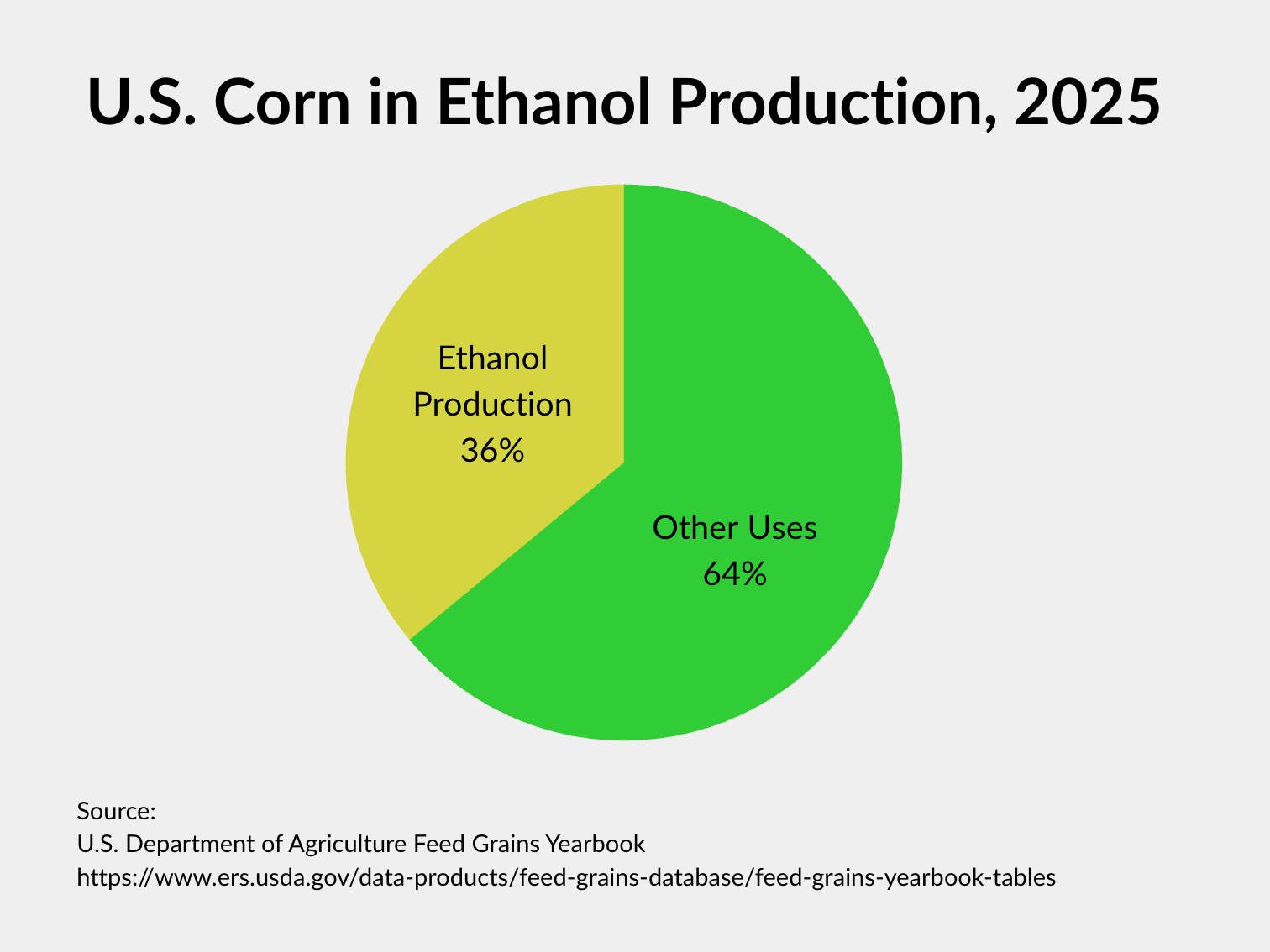
Over 1/3 of the US corn harvest goes to provide about 10% of our gasoline use.3 But even if the whole corn harvest was used for fuel, it would not get us halfway to replacing oil for gasoline.
-
Replacing just oil-based gasoline fuel (57% of transportation energy4) with ethanol would require a 4-5X increase in corn production, and using all that corn for ethanol. This would require more arable land than currently exists in the US.
-
Myth: Government-dictated ethanol reduces pollution and GHG emissions.
Truth: Ethanol, because of its scalability limitations, could not significantly reduce these emissions even if it had none of them. And it has significant emissions, especially GHGs.
-
The existing evidence shows that once the life-cycle CO2 emissions from the production and use of corn-based ethanol induced by the RFS are fully accounted for, the RFS not only doesn’t reduce CO2 emissions compared to gasoline but may actually increase them.5
-
Even if ethanol did have significantly less GHG emissions than gasoline, it couldn’t significantly reduce global emissions because of its non-scalability.
-
The US causes <1/7 of global CO2 emissions and falling.6 In order to significantly affect global GHGs, ethanol would have to scale worldwide—but it can’t.
-
Not only does ethanol not significantly lower GHG emissions but it also does not significantly reduce air pollution compared to gasoline.
-
Ethanol reduces some tailpipe emissions when burned. However at higher blends like E10 and E15, ethanol raises gasoline’s vapor pressure and causes the fuel to evaporate more readily, which can result in more emissions overall.
The right path forward: allow ethanol, including E15, to compete on a free market—no mandates, no subsidies
The only reasonable path forward on ethanol, including E15, is a phaseout of government-dictated ethanol, ending with truly free fuel choice—including the choice to use E15.
-
The only real “argument” for government-dictated ethanol is that the special interests who depend on it are incredibly addicted to it and incredibly powerful over a large swath of elected officials.
-
Personally, I have met hundreds of elected officials and not one has ever tried to make a serious intellectual case for ethanol to me. Knowing that I am both pro-freedom and knowledgeable about energy technology and economics, they concede in one form or another that it’s politically required for them.
-
The issue of government-dictated ethanol is difficult only because it has gotten American farmers (and to a lesser extent larger refiners) so addicted to other people’s money that they will do anything politically to keep it.
-
The fact that struggling corn farmers would benefit short-term from an expansion of the ethanol mandate is not a good argument for it—it’s just a call for a naked wealth transfer from some Americans to others.
-
We can empathize with the plight of farmers and others who have become addicted to the corn ethanol mandate, while still acknowledging that it needs to go. The sensible approach is a gradual but complete phaseout.
-
Some politicians and industry leaders supporting expanding government-dictated ethanol with “year round E15” seem to genuinely think that they’re supporting a free market, and have confidence that ethanol can be genuinely competitive. They should be totally agreeable to a phaseout of the ethanol mandate.
-
Rep. Derek Schmidt (R-KS), Jan 16, 2026: “Making E15 available year-round—as a choice for consumers who want it, not a mandate—is good for Kansas farmers and our rural economy.”7
-
Sen. Kevin Cramer (R-ND), 2025: “Year-round E15 “increases consumer choice at the pump.”8
-
Rep. Adrian Smith (R-NE), 2024: “It’s ultimately about retailers engaging with consumers, and it’s not a mandate.”9
-
Emily Skor, CEO of Growth Energy, Jan 23, 2026: “E15 delivers cost savings for consumers and generates long-term demand for American agriculture. These have been the facts during the twelve-year-long debate over the simple act of allowing consumers the choice to buy a better value fuel year-round.”10
-
Illinois Corn Growers Association, Jan 22, 2026: “Fuel retailers can decide to sell E15 or not. Year-round E15 policy simply opens the marketplace and is not a mandate.”11
-
-
The ideal compromise for the E15 council is: everyone should agree to year-round E15 and other blends of ethanol in exchange for phasing out the ethanol mandate and eliminating ethanol subsidies.
-
Congress has the power to phase out the RFS, and should use it. A reasonable path forward is to cap volumes at 2025 actual production levels, then reduce by 20 percentage points a year for 5 years until it’s gone.
-
Once the ethanol mandate is gone, it’s possible the ethanol industry will find innovative ways to earn market share. E.g., if government doesn’t dictate that ethanol be blended above needed quantities in gasoline, maybe we will see high-performance E100 vehicles. Everyone who feels enthusiasm about ethanol economically should welcome freer fuel choice that will unleash whatever potential it has.
Michelle Hung, Steffen Henne, and Daniil Gorbatenko contributed to this piece.
References
-
Argus Media - API, ethanol groups clinch deal on US biofuel bill↩
-
U.S. Environmental Protection Agency - Overview of the Renewable Fuel Standard Program↩
-
US Department of Agriculture - Feed Grains Database - Feed Grains: Yearbook Tables
U.S. Energy Information Administration - U.S. Product Supplied of Finished Motor Gasoline↩
-
U.S. Energy Information Administration - Gasoline explained↩
-
National Library of Medicine - Environmental outcomes of the US Renewable Fuel Standard↩
-
U.S. EPA - WHAT THEY ARE SAYING: Leaders Thank EPA for E15 Year-Round Ahead of the Summer Driving Season↩
-
AgriPulse - Year-round E15 sales, small refinery credits authorized in funding bill↩
-
AgriMarketing - GROWTH ENERGY: CONGRESS' "RURAL ENERGY COUNCIL" IS A DISGRACE↩